AI App Ideas You Can Vibe-Code Fast (2026): 6 Types That Ship in a Weekend — and How to Pick One
The apps solo builders actually ship fast fall into six repeatable types — a one-feature identifier, an unbundle of a bloated tool, a content utility, a community-branded consumer app, a polish-wins-the-category app, and a low-ticket mini-product. But the code is the cheap part now. The hard part is picking a real Job, keeping the offer to one thing, validating before you build — and then promoting it, because an app nobody can find makes $0.
A catalog of app types you can vibe-code quickly, with real examples and the revenue figures makers have reported, plus a framework for choosing and simplifying an idea instead of guessing. The dollar figures come from public maker breakdowns and often reflect a single peak month, not current or typical earnings — we haven't independently audited them, so read them as illustrative of what a type can reach. The build tools change monthly; the way you pick and ship does not.
What can you actually vibe-code fast in 2026?
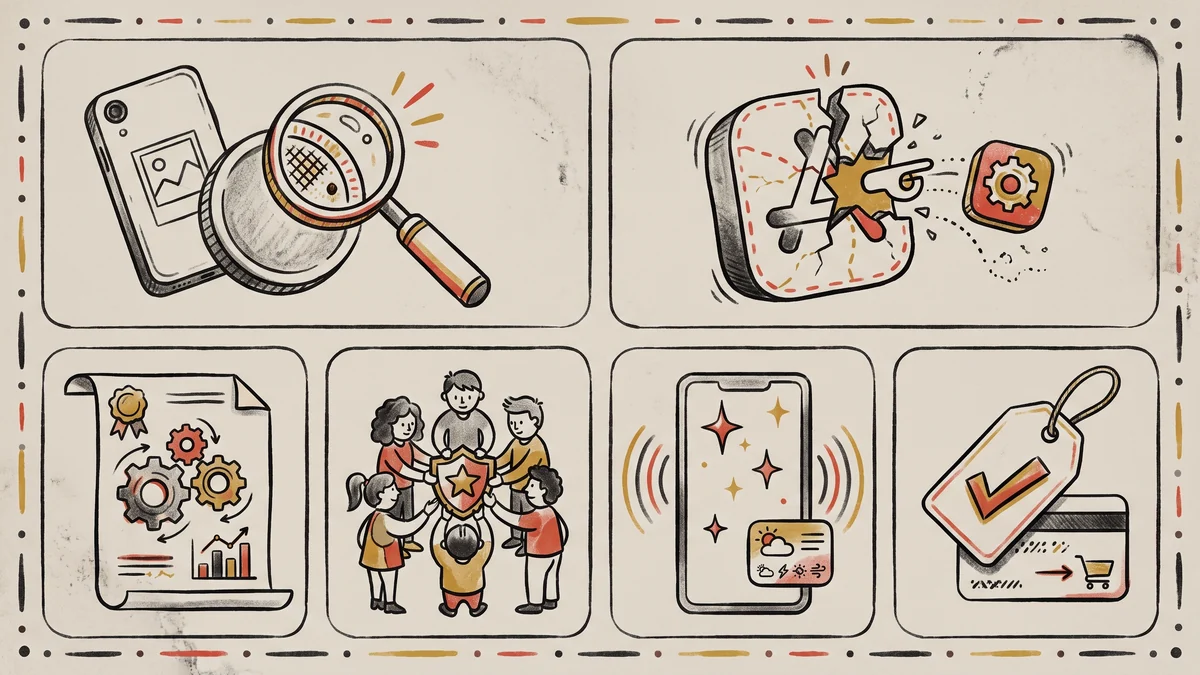
Six types cover almost everything a solo builder ships fast: a single-feature identifier (photo or prompt in, one answer out), an unbundle or clone of an overpriced tool, a content/SEO utility, a community-branded consumer app, a polished app that wins a crowded category on feel, and a low-ticket mini-product. Each is small on purpose — one job, one screen flow — which is exactly why a weekend is enough. Pick the type that matches a problem you can already picture a specific person having.
| Type | What it is | Real example | Best for |
|---|---|---|---|
| One-feature identifier | Camera/prompt → one AI answer | CoinSnap (coin ID) | Fastest path to a paid app |
| Unbundle / clone | Rebuild the one feature you use from a bloated tool | Calendly-style booking clone | Builders who resent a subscription |
| Content / SEO utility | Automate one repetitive content task, often free | Topical-map generator | Scratch-your-own-itch + lead-gen |
| Community-branded app | Re-skin a proven model for one niche | Upward (dating for Christians) | A tight audience that shares |
| Polish wins the category | Same feature, dramatically better feel | Calorie tracker with widgets | Craft over a blue-ocean idea |
| Low-ticket mini-product | One bounded outcome behind a ~$10 offer | Paid 30-day challenge | Anyone with a small audience |
Type 1 — the single-feature identifier
Point a camera or paste a prompt, get exactly one answer: what is this, what's it worth, is this good. No settings maze, no feed — one input, one AI call, one result screen. It's the fastest thing to ship because the whole app is that loop plus a subscription, and the model call costs a fraction of a cent per scan.
In maker breakdowns, coin identifier CoinSnap has been reported (a peak-month figure, unverified) near $500k/month, with rock, antique, and insect identifiers reported in the tens of thousands per month. The pattern: take a "what is this / what's it worth" question a collector or hobbyist asks repeatedly, and add one thing free ChatGPT won't — a saved collection, scan history, a value dashboard — so a subscription makes sense. Build it with Claude Code or Codex plus React Native and Expo and the hard part is the one differentiator, not the plumbing.
Type 2 — the unbundle or clone
Take a big, expensive tool you personally use for exactly one feature, and rebuild just that feature as its own app. Or clone an old pre-AI app whose free plan is bad and whose paid plan overcharges, and ship a leaner version. Scope is tiny because the spec already exists — you're copying a proven thing down to one job, with no product-discovery risk.
A booking tool in the shape of Calendly is "probably a weekend." A site-explorer-only tool unbundles the one feature many people touch in a suite whose Lite plan runs about $99/month. A link-in-bio page replaces a tool whose paid tier you resented. The strongest targets have no AI or third-party API cost, so they run on hosting plus a database for pennies and scale almost infinitely. Prefer a tool people already use but quietly hate — the demand is proven by the money they already spend.
Type 3 — the content or SEO utility
Wrap a model around one repetitive knowledge task and give it a thin interface: an SEO topical-map generator, a blog-to-podcast converter, a news dashboard, a timestamp automator. These are usually the "scratch your own itch" apps — you build the thing you were doing by hand — and they're often shipped free to build an audience you upsell later.
One SEO topical-map tool replaced a service its maker had paid $1,000 and waited six weeks for; he built his own, it made money, and he sold the company. Another maker shipped a free utility purely to stop paying $10/month for something he knew he could build in an afternoon. The trick is the same as Type 1: one workflow, one screen, no accounts required for the free version. If you can validate your idea with a free tool that solves your own problem, you also get your first users for free.
Type 4 — the community-branded consumer app
Take a model that already works — dating, screen-time blocking, course hosting, translation — and re-brand it tightly for one community, country, profession, or faith, usually adding the one feature the incumbent neglects or the local law the big players ignore. The core mechanic is validated; you re-skin, localize, and add a single differentiator. The niche does your marketing: the app gets shared inside the community it's named for.
Reported figures (from maker breakdowns, unverified and likely peak-month): a dating app built for Christians, Upward, in the mid-six figures per month; a course platform built for the GDPR-bound French market, Teachizy, in the tens of thousands per month; and a design-subscription for churches, Pixel Painters, in the same range. None invented a category — they niched down a working one until a specific person said "that's for me," often by adding the one feature the incumbent neglects or the local law the big players ignore.
Type 5 — polish wins a crowded category
When coding is trivial, the moat moves to feel. Enter an oversaturated category — calorie tracking, budgeting, journaling — and stand out on interaction, animation, haptics, a mascot, consistent icons, and home-screen widgets, not on a new feature. The bet is that people will switch a tracker they already use for one that feels dramatically nicer.
One maker rebuilt lock-screen widgets in a few hours and got a holographic-sticker interaction "in two prompts," then treated widgets as a retention cheat code. Another framed a calorie tracker as "type what you ate like Apple Notes" and a single concept post drew roughly 800 waitlist signups in a day — before the app existed. This is the type where the build is the easy 20% and the packaging is the other 80%.
Type 6 — the low-ticket mini-product
Not every idea needs to be a SaaS. A small, bounded outcome behind a simple ~$10 offer works too: a paywalled 30-day challenge with a dashboard and a prize, a paid resume rewrite, a premium newsletter tier, a calculator. The AI does the fulfillment, so there's nothing to deliver by hand, and a landing page plus a paywall plus one dashboard is a template you can vibe-code in minutes.
The appeal is speed to revenue: no accounts system, no retention mechanics, one flat price for one result. It's the lowest-risk way to test whether people will pay you at all before you commit to a bigger build.
How much do these actually make?
Here's the honest version. The figures below are as reported in public maker breakdowns of app revenue — not our data, not audited, and often a single peak month rather than current or typical earnings. They show what a type can reach at the top end, not what you should expect; for every app here there are thousands earning nothing. We've kept only apps that verifiably exist and dropped figures we couldn't tie to a real product.
| App | Type | Reported (peak, unverified) |
|---|---|---|
| CoinSnap (coin identifier) | Single-feature identifier | ~$500k / month |
| Upward (dating for Christians) | Community-branded | mid-six figures / month |
| Rock Identifier | Single-feature identifier | tens of thousands / month |
| Teachizy (courses, France) | Community-branded | tens of thousands / month |
| Pixel Painters (design for churches) | Community-branded | tens of thousands / month |
How to pick an idea worth building
Most idea videos say "ask ChatGPT for ideas." Don't. Generate candidates deliberately, then run them through a filter. This merges what the makers do with Ivan Zamesin's Next Move Theory (Advanced Jobs-To-Be-Done), which is just a sharper way to say the same thing.
- 01Start from a Job, not a feature. Write the outcome someone already wants as one sentence — when [situation], I want to [outcome], so I can [bigger outcome] — and name what they use today. If the sentence needs two "and"s, that's two apps. Split it.
- 02Generate candidates with five proven moves: scratch your own itch; unbundle a bloated tool to the one feature you use; clone an overpriced pre-AI app (prefer ones with no API cost); document your day to spot repetitive tasks; and follow the money on Product Hunt, AppSumo, Reddit, and app-intelligence charts to find models already earning, then re-aim them at a new niche.
- 03Pick one narrow segment by how it judges success, not by demographics. A real segment shares the same Job and the same top one-to-three success criteria in the same order — "paid within 7 days," "under $20/month," "set up in 10 minutes." "Christians," "French coaches," "calisthenics, not all gym-goers" are segments because they share a Job, not an age bracket.
- 04Run four go/no-go questions before building: Can you do their main task with an edge they'd actually feel? Can you earn a margin — will they pay more than it costs to serve them? Can you reach them, and are enough of them fed up enough to switch? Is there real money in it? Add a hard fail for any legal blocker.
- 05Name the switch-worthy edge — the one-to-three criteria every current option, including "do nothing," handles badly. That's your reason to exist: the feature that beats free ChatGPT, the thing the incumbent neglects, or pure feel.
- 06Keep the offer to one Big Job, described in the customer's checkable success criteria ("invoices paid in 7 days"), not adjectives ("fast, powerful, seamless"). If your pitch could describe five other apps, narrow it.
- 07Validate cheaply before you build — the step the tutorials skip. Post a concept video, run a fake-door landing page, or talk to six to eight people about the last time they actually did the Job (not "would you use this?"). One maker's concept tweet was the MVP: ~800 signups before a line of code.
Building it is half the job — you have to get it found
Every one of these ideas ends at "ship it," and that's where most makers stop and most apps die. Coding is now the fast, cheap part — minutes to hours with Claude Code, Cursor, Lovable, or Bolt — which means a working app is no longer a moat. Discoverability is. If the term is new, start with what vibe coding is and pick a build tool from the best vibe-coding tools.
Look again at the earners. The community-branded apps win because the brand is the distribution channel: the app gets shared inside the group it's named for. The polished apps win because a concept post did hundreds of thousands of views while the same app posted a day earlier with less polish got seven likes — the packaging, not the build, moved the numbers. Validation itself is already marketing.
So once it works, spend the rest of your time making sure the right 1,000 people ever see it: get your first users through a channel your segment already lives in, make the app go viral with a built-in loop, run social media the way makers actually should, and do your own SEO with Claude Code so AI answers and search send people your way. A weekend build plus a real distribution plan beats a beautiful app nobody can find — every time.
A note on the revenue figures
The dollar figures here are as reported in public maker breakdowns of app revenue — the app-teardown videos and posts that circulate these numbers. They are not our data, not audited, and frequently reflect a single peak month rather than current or steady earnings. We couldn't independently confirm every figure against an app-intelligence source, so we dropped the ones we couldn't tie to a real product and labelled the rest as reported estimates. If you want to check an app's own trajectory, the platforms below publish store-revenue estimates.
- Sensor Tower
App-store intelligence platform that estimates app downloads and revenue — a place to sanity-check any app's scale yourself.
- AppMagic
Mobile-app market data and revenue estimates you can use to verify figures independently.
Frequently asked questions
- What kind of app is easiest to vibe-code first?
- A single-feature identifier or a clone of a tool you already use. Both have a tiny scope — one input, one output — and a proven spec, so there's no product-discovery risk. You're building one flow, not a platform.
- Do these apps really make money?
- Some do — the top examples have been reported in maker breakdowns anywhere from tens of thousands to ~$500k/month — but those are the outliers, and the figures are unverified, often peak-month numbers, not typical results. Most apps in every category earn nothing. The earners share two traits: a very simple product and a built-in way to get found.
- How do I come up with an idea instead of guessing?
- Start from a Job someone already does, not a feature. Generate candidates by scratching your own itch, unbundling bloated tools, cloning overpriced apps, documenting your daily annoyances, and following the money — then keep only the ones where you can reach the first users and offer an edge they'd feel.
- How simple should the app be?
- One Big Job, done end to end. If you describe it with "and also," you're building two products. The apps that earn are described by their makers as "literally one feature" — the simplicity is the point, not a compromise.
- Do I need to know how to code?
- No. Tools like Claude Code, Cursor, Lovable, and Bolt let you build a shippable app by describing it, and many of the examples here were built by non-engineers. Coding is the part AI handles; picking the idea and getting users are the parts that are still on you.
- Isn't it too late — aren't these markets saturated?
- Saturation is a signal that people pay for the Job, not a reason to quit. You win a crowded category by being clearly best on the one or two things a narrow segment cares most about — a neglected feature, a specific community, or dramatically better feel — not by being first.