How to Make Your App Go Viral with UGC: Why Views Alone Get You Nothing (2026)
Going viral isn't luck — it's a format that earns watch time, run at volume. The founder of nomadtable grew it past a million downloads, solo, by ignoring view counts and chasing one number: how many people keep watching past the first three seconds. Here's that UGC playbook, with his real figures attributed throughout.
Most 'go viral' advice is generic. This is the app-focused version, reverse-engineered from how Jay Raavi grew the solo-travel app nomadtable to over a million downloads with no team, no paid ads, and no VC — as he laid it out on the Superwall podcast. Every number here is his, and marked as such; treat them as one founder's results, not a guarantee.
Why does a viral video get no downloads?
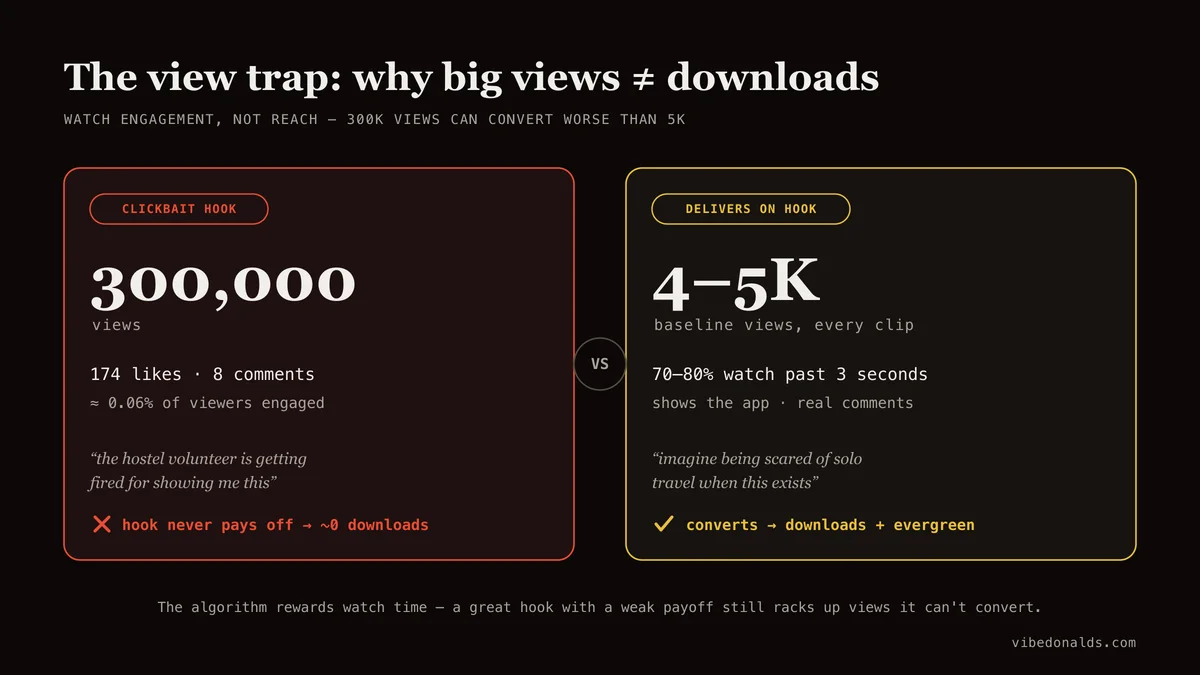
Views are a vanity metric. One of Jay's early clips pulled 300,000 views but only 174 likes and 8 comments — watched, but not acted on. The hook was clickbait ('the hostel volunteer is getting fired for showing me this'), so the algorithm pushed it for watch time, but it never delivered on the promise, so nobody downloaded.
The lesson: a video that goes viral but has nothing to do with your product converts no one. A smaller clip that actually shows your app and pays off its hook beats a clickbait monster every time. Chase downloads, not view count.
What's the one metric that predicts virality?
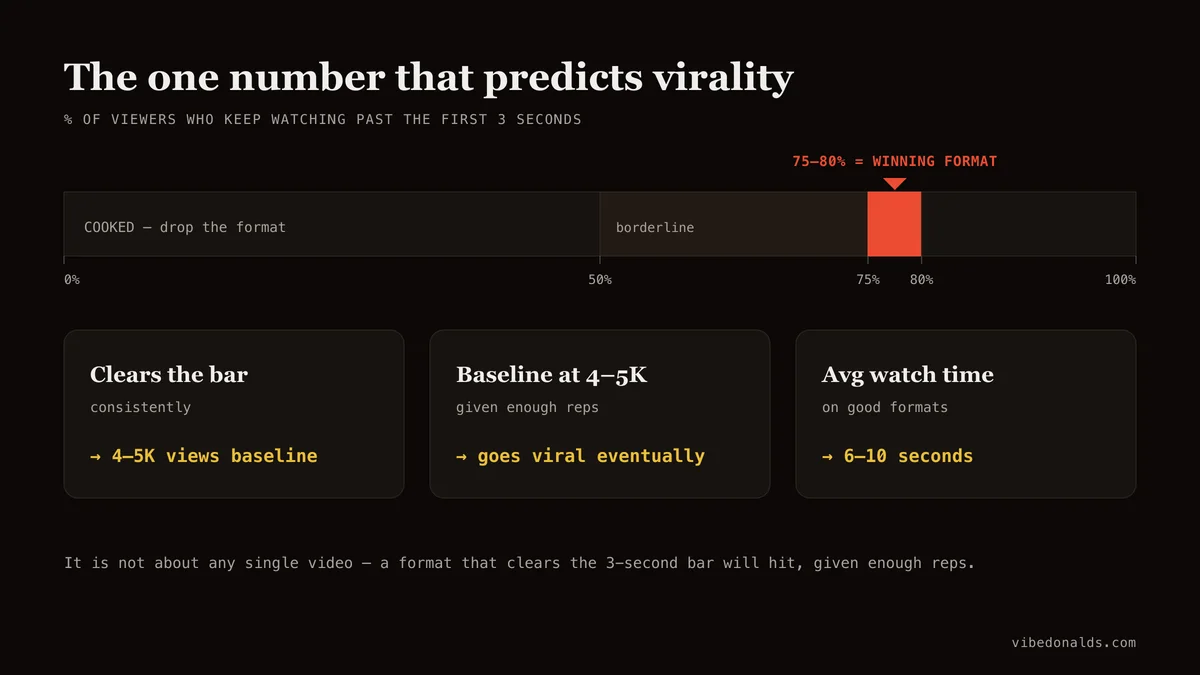
Watch time past three seconds. Jay calls a format a winner when 75–80% of viewers keep watching past the first three seconds — the signal that the hook landed. Hit it consistently and the format does roughly 4,000–5,000 views as a baseline, and goes properly viral eventually.
Below about 50% retention, the format is cooked — drop it fast. The point isn't any single video; it's that a format clearing the three-second bar will hit, given enough reps. Average watch time on his good formats runs about 6–10 seconds.
Why test the format yourself before hiring creators?
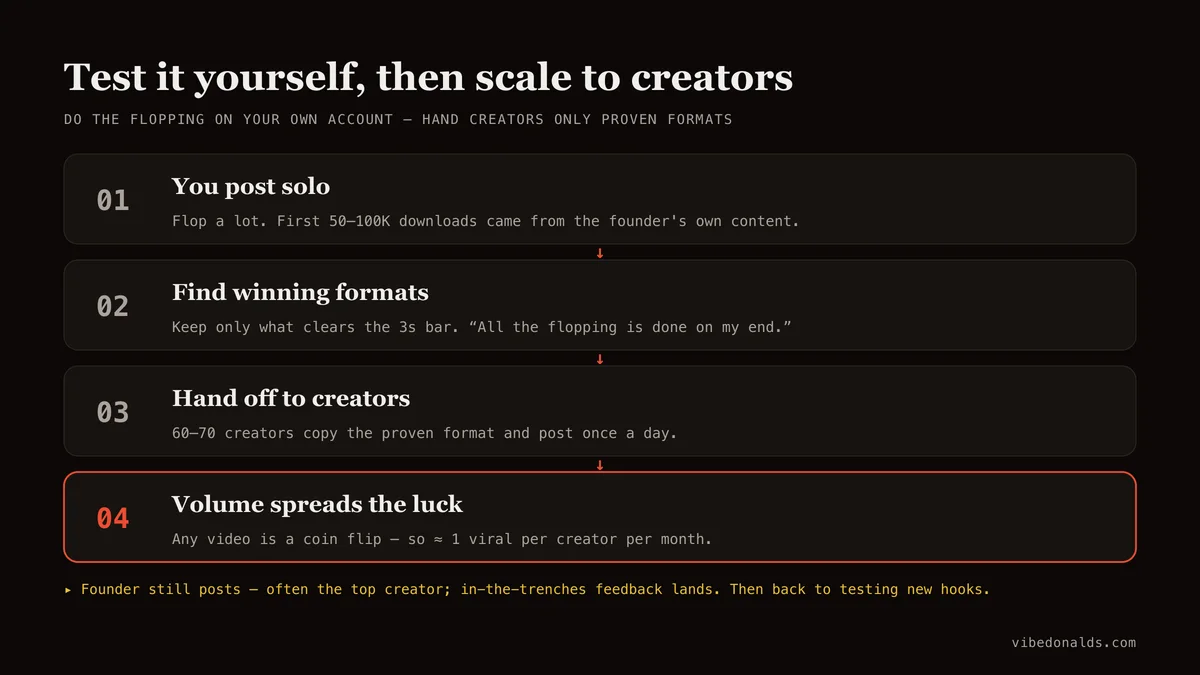
Jay got his first 50,000–100,000 downloads from his own posting, before hiring anyone. He used that to find the formats that clear the metric — 'all the flopping is done on my end' — and only then handed proven formats to creators. Paying creators to guess is how you burn money.
He still posts, and is often his own top creator. Being in the trenches makes his feedback land — creators take direction better from someone doing the same work, not a founder barking from the sidelines.
What makes a hook actually work?
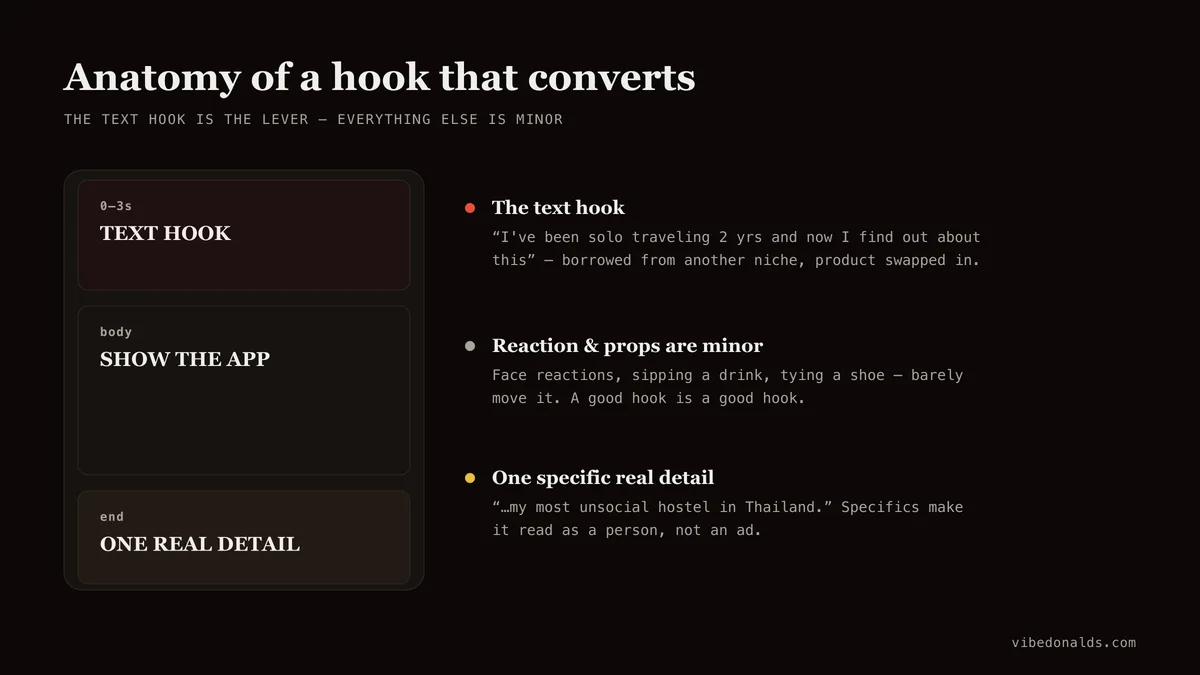
The text hook is the lever, not the acting. Jay's first viral video borrowed a format from another niche — 'I've been solo traveling for 2 years and now I find out about this' — then went straight into the app. A good text hook works across creators; reaction shots and props (sipping a drink, tying a shoe) barely move the needle.
Specific details are what make it feel real instead of an ad. Ending on 'where was this when I had the most unsocial hostel in Thailand' reads as a person, not a brand. Borrow hooks that already work in other niches and swap your product in — Jay didn't invent that one, he ported it.
Why does a big creator network matter?
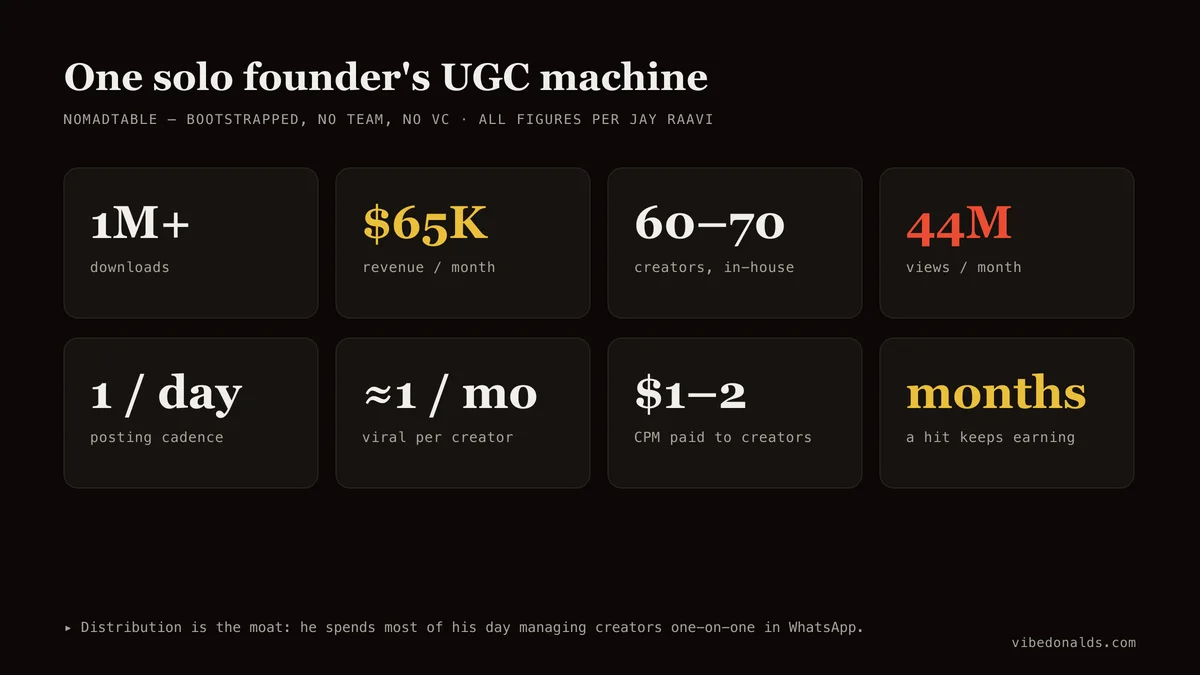
Virality is a good format plus volume plus luck. A format that clears the three-second bar will hit — but which specific video pops is close to random. A network spreads that luck: Jay runs 60–70 creators posting daily, so something goes viral most weeks even though any one video is a coin flip.
Volume pays even when nothing pops. Sixty creators each doing a few thousand baseline views a day is a lot of downloads with zero viral hits. And the hits are evergreen — a strong video keeps pulling views for months (one of his ran for a year), like an SEO article that compounds.
What do you pay UGC creators?
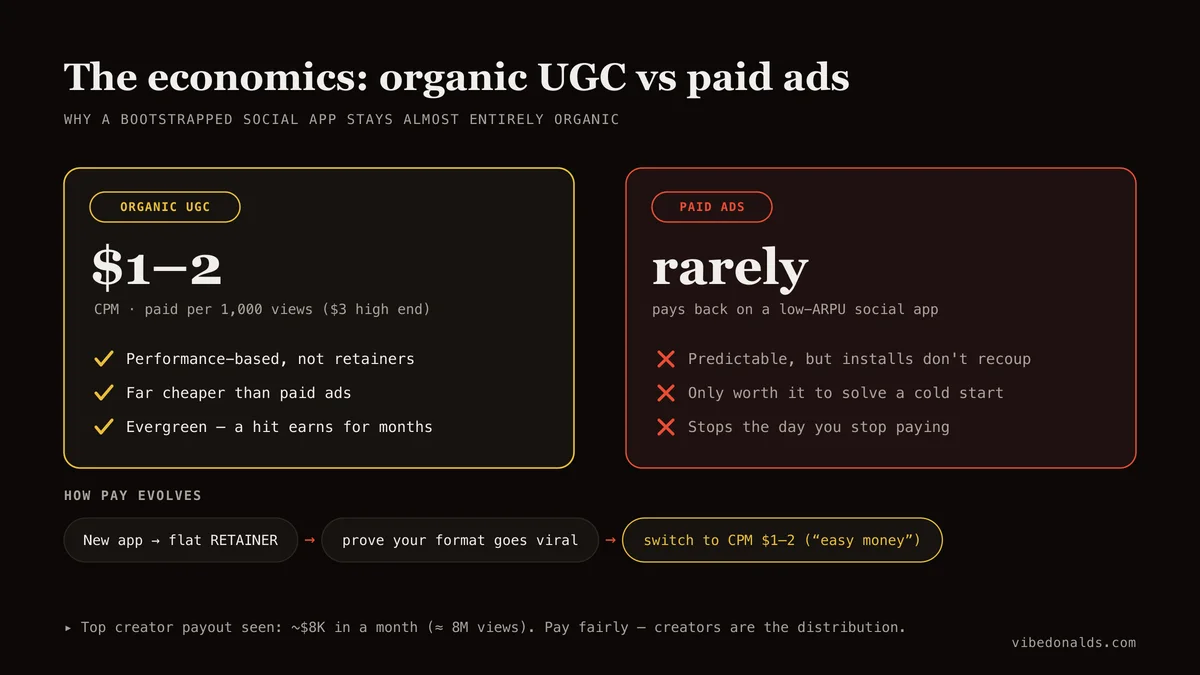
Mostly performance-based: Jay cites roughly $1–2 per thousand views (CPM), with $3 the high end he's seen — far cheaper than paid ads. But start with retainers, because until you can show creators that your format goes viral, no one will take a CPM deal.
Prove it with your own account first, then the CPM reads as easy money: 'copy this format, I've done it eight times, it works.' He tracks views on old posts for about three months and pays fairly — the creator relationship is the distribution, so he protects it.
Why not just run paid ads?
For a social app, paid ads rarely pay back. The revenue per user is low, so even cheap installs don't recoup — Jay stays almost entirely organic and is openly bearish on paid for social apps. Paid can make sense only to solve a cold start, never as the long-term engine.
Organic UGC is cheaper traffic and builds the word of mouth a social app actually runs on — he estimates 10–15% of new users now arrive that way. The trade-off is honest: UGC is less predictable than ads, but far cheaper, and it compounds instead of stopping the day you stop paying.
Where does this fit for a vibe-coded app?
This is the deep end of one channel. If you're earlier — no users yet — start with the channel map and the setup basics, then come back here to make the videos actually convert.
And list your app where it's crawlable while the videos do their work, so the people (and AI engines) searching for a tool like yours can find it.
- How to get your first users
The channel map and the UGC setup basics — start here if your app has no users yet.
- Where to list your app
The directories that get you found by people and AI engines while your videos run.
- List your app on Vibedonalds
Free after a quick review — a niche, crawlable directory for vibe-coded and AI-built products.
Frequently asked questions
- Why does my TikTok get views but no downloads?
- Probably a clickbait hook the video never delivers on. TikTok rewards watch time, so a misleading hook racks up views while converting no one. Make the hook match what your app actually does, show the product, and let the comments carry the link. Chase downloads, not view count.
- What's a good 3-second retention rate on TikTok?
- Around 75–80% of viewers watching past the first three seconds is the bar one founder uses to call a format a winner. Hit it consistently and the format tends to do a few thousand baseline views and goes viral eventually. Under about 50%, drop the format.
- Should I post myself or hire creators first?
- Post yourself first. Use your own account to find formats that clear the retention bar, then hand those proven formats to creators. Paying creators to guess wastes money — do the flopping yourself, then scale only what already works.
- How much do UGC creators cost for an app?
- One founder pays roughly $1–2 per thousand views (CPM), performance-based, with $3 the high end he's seen — far cheaper than paid ads. Expect to start on flat retainers until you can prove your format goes viral, then switch to CPM.
- Do paid ads work for a social app?
- Usually not as the main engine. Social apps have low revenue per user, so paid installs rarely pay back. Use organic UGC for cheap traffic and word of mouth, and reserve paid for solving a cold start, if you use it at all.
- How often will a good format go viral?
- About once a month per creator, by one founder's count — some months three or four, some none. Any single video is luck, but a format clearing the three-second bar will hit given enough reps, which is exactly why a creator network matters.