Pomerado
Service that turns websites into MCP and API tools for AI agents, with managed logins and an open-source core.
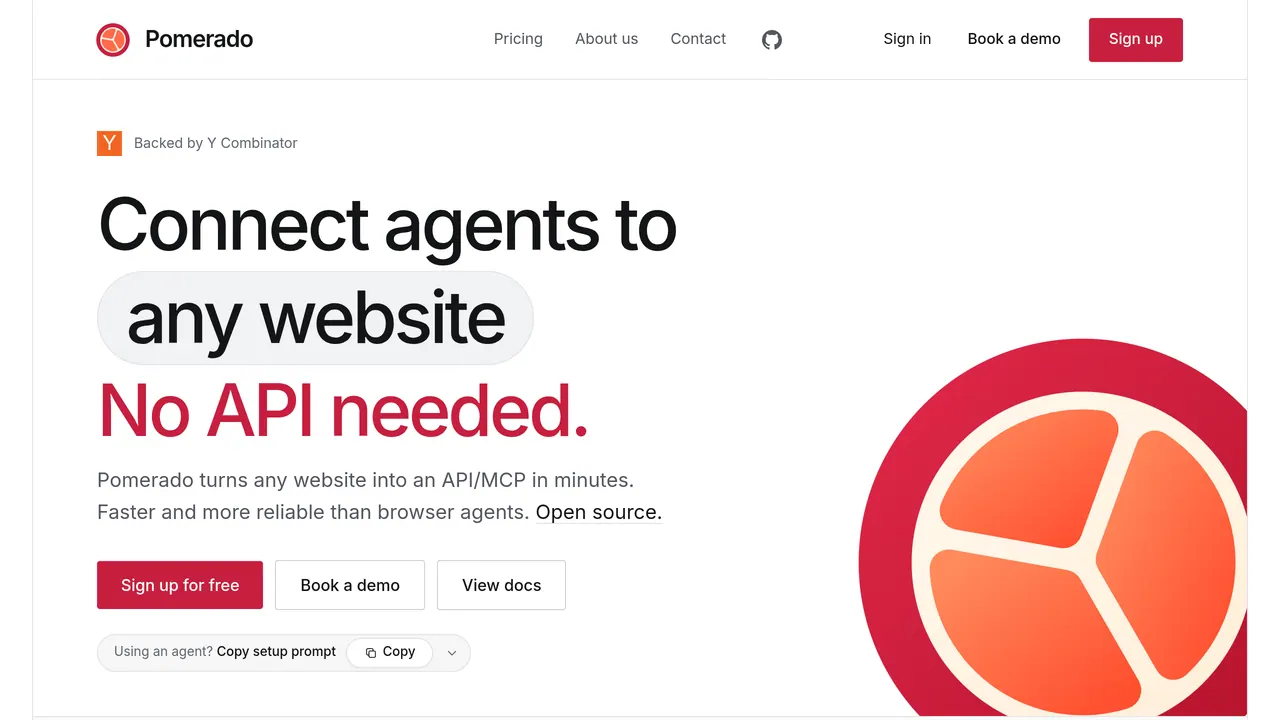
Pomerado builds MCP and API integrations for websites that have no API, including sites behind a login and two-factor authentication, so an agent calls a deterministic tool instead of working through pages in a browser. Free gives 100 tool calls a day; Premium is $50 a month billed monthly or $45 a month with yearly billing.
About Pomerado
You describe the task in plain language, or ask a coding agent such as Codex, Claude or Cursor for the integration, and Pomerado explores the site, completes your example and generalizes it into a tool your agent calls over MCP or the API. Each integration is either read-only or allowed to make changes, and a write build performs the action once while it builds.
Pomerado Cloud hosts each integration with access control, handles sign-in including two-factor codes, uses a managed browser fleet for bot protection, and detects when a site changes and repairs the integration. Logins can be passed with each request instead of stored, and Pomerado says task results are erased once delivered, or within 60 minutes if never read.
The core is open source under the MIT license: the minter, which builds integrations in a real Chromium browser, the Guardian reviewer, and a standalone host that serves each integration as an MCP server on your own machine; versions 0.1.2 and earlier were AGPL-3.0-only. Self-hosting needs macOS or Linux, Node 24 and an OpenAI API key for building, and integrations are saved as source code you own.
Free includes 100 tool calls a day, 10 new integrations a month and 1 account per website. Premium raises that to 1,000 calls a day and 100 new integrations a month, while Business, priced on request, adds 100,000+ calls a day, unlimited accounts per website, custom 2FA and proxying, MCP code ownership, private team integrations, audit logs, SLAs and 24/7 support.
Sources: pomerado.ai and github.com/Pomerado/pomerado, read 2026-10-27
Pomerado pros and cons
Pros
- No account is needed to try the hosted MCP server with a read-only task.
- Pomerado says its integrations are deterministic APIs that run in seconds, where browser agents reason through every page.
- Everything needed to build and run integrations yourself is in the open-source repository, with no Pomerado account required.
- Credentials are stored only if you choose to save them, and the core refuses a sign-in form whose fields or submit go to another website.
Cons
- Free is capped at 100 tool calls a day and 10 new integrations a month, and Free and Premium allow 1 account per website.
- Self-hosting the core requires your own OpenAI API key, since it uses OpenAI models to build and review integrations.
- Cancelling a running job does not undo an action already sent to a website, which may still have taken effect.
Tagged
- Agentic Mode
Pomerado alternatives
The closest alternatives to Pomerado.
Related reading
Featured on Vibedonalds
Own Pomerado? Add this badge to your site to show you’re listed — and link back to your profile here.

<a href="https://vibedonalds.com/tools/pomerado" target="_blank" rel="noopener">
  <img src="https://vibedonalds.com/badge/featured-on-vibedonalds.svg" alt="Pomerado — Featured on Vibedonalds" width="240" height="60" loading="lazy" />
</a>Frequently asked questions
- What is Pomerado?
- Pomerado is a service that turns websites into MCP and API tools for AI agents, with managed logins and an open-source core.
- Is Pomerado free?
- Pomerado offers a free tier and paid plans with higher limits or premium features.
- What platforms does Pomerado support?
- Pomerado's own site lists it for macOS and Linux.
- What are the alternatives to Pomerado?
- The closest alternatives to Pomerado are Tabstack Browser Automation, MCP-Builder.ai.
- What are the downsides of Pomerado?
- Free is capped at 100 tool calls a day and 10 new integrations a month, and Free and Premium allow 1 account per website. Self-hosting the core requires your own OpenAI API key, since it uses OpenAI models to build and review integrations. Cancelling a running job does not undo an action already sent to a website, which may still have taken effect.
- Is Pomerado open source?
- Yes: its GitHub repository holds the complete Pomerado core under the MIT license, with everything needed to build and run integrations yourself and no account required; versions 0.1.2 and earlier were AGPL-3.0-only. Pomerado Cloud runs the same core as a managed service with hosting, saved logins and automatic repair.
- How much does Pomerado cost?
- Free costs $0 with 100 tool calls a day and 10 new integrations a month. Premium is $50 a month billed monthly, or $45 a month with yearly billing, for 1,000 calls a day and 100 new integrations a month. Business pricing is on request.
- Which AI agents work with Pomerado?
- The homepage gives setup commands for Claude Code and Codex and sends other agents to its docs; for the self-hosted server, the README lists MCP clients that run local servers, such as Claude Code, Codex, Cursor, VS Code, Claude Desktop and Gemini CLI. Your agent can run on any model.
- Can Pomerado sign in to websites?
- Yes: integrations sign in to portals, dashboards and internal tools to read data and take actions, including sites that use two-factor codes. You can pass logins with each API request instead of storing them, and Pomerado keeps hashes of sign-in identifiers to enforce its limit of one login per website.
- What data does Pomerado keep?
- Pomerado says it keeps only the data needed to keep an integration working, erases task results once delivered or within 60 minutes if unread, stores credentials only if you save them, and uses models to strip personal information once a task is done.