OpenMuse
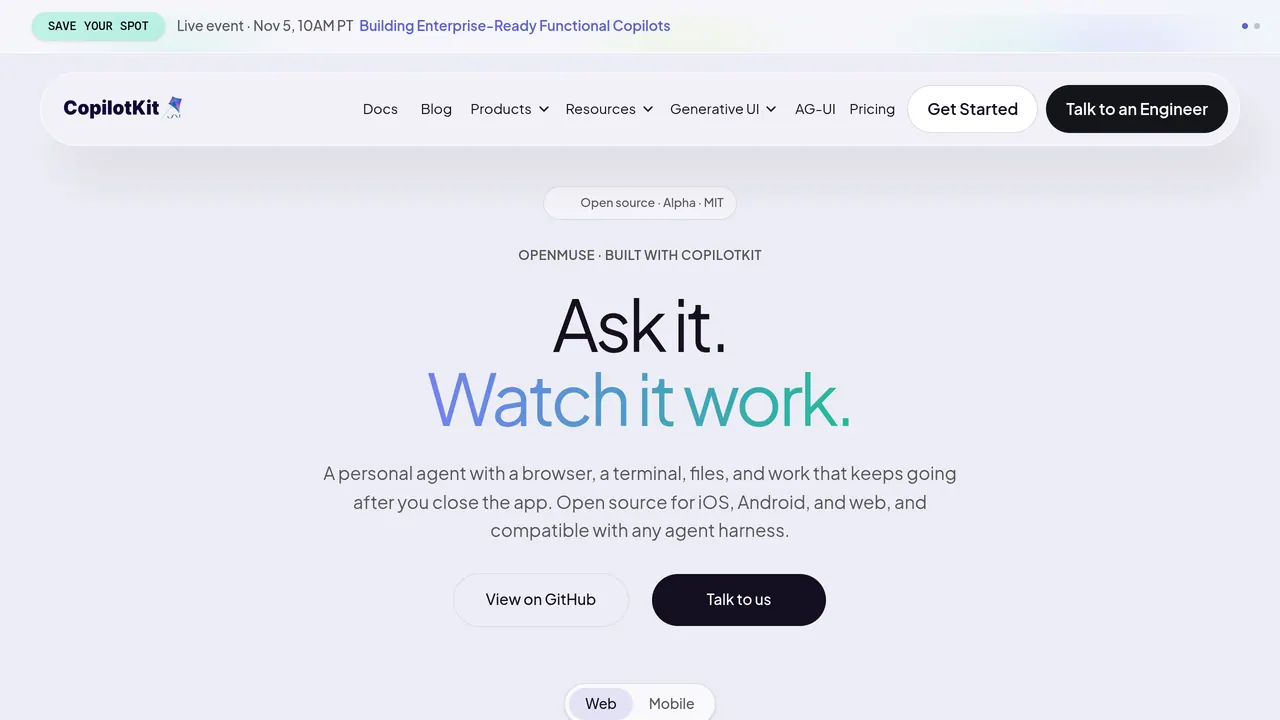
CopilotKit's open-source personal agent with its own browser, terminal and files, for iOS, Android and web.
OpenMuse is CopilotKit's open-source (MIT) personal agent template, in alpha, with its own browser, optional Linux terminal and files, for iOS, Android and web. The code is free; the README also requires a key for CopilotKit Intelligence, a separate service whose free hosted plan has 1,000 interactions a month.
About OpenMuse
CopilotKit describes OpenMuse as an open-source personal agent you run yourself, which keeps working on tasks after you close the app. It is a template to clone and change under the MIT license, and one CopilotKit React Native codebase drives the phone app and the web app. OpenMuse speaks AG-UI, so CopilotKit says you can bring the agent harness and frontend you already use.
The alpha has streamed chat with inline email, browser, PDF, plan and finance cards, an agent computer with a persistent Chromium profile and an optional Linux terminal you can take over, and durable task plans you can pause, resume, cancel or retry. It also tracks goals with recurring checks on public pages and handles documents from email attachment to filled PDF to reviewed reply. Gmail and Calendar connect over Google OAuth, and every send and every calendar change waits for your review.
You point it at an OpenAI, Anthropic or Google model, and provider keys stay on the server. Data lives on your machine by default, in embedded PGlite and a local .openmuse directory with Google credentials encrypted at rest, and you can switch to PostgreSQL. Web search uses Parallel's free, keyless Search MCP and sends queries and context to Parallel, and the README says the CopilotKit SDK sends runtime telemetry to PostHog with full capture by default.
The README lists Node 24 LTS, pnpm and a CopilotKit Intelligence project key as requirements, and says every deployment needs that key because Intelligence stores the chat threads. CopilotKit's pricing page offers free hosted Intelligence with 1,000 interactions per organization each month, and pay as you go is $49 a month, billed monthly, with 10,000 interactions included. A Render blueprint deploys the API, the web app and a private browser, and one deployment serves a single owner behind a shared access key.
Sources: copilotkit.ai/openmuse, github.com/CopilotKit/OpenMuse and /pricing, read 2026-10-27
OpenMuse pros and cons
Pros
- Open source under the MIT license, so you can clone the template and change anything from the interface to the agent harness.
- No email is sent and no calendar event changed without its own stored review, and page, email and document content never counts as permission to act.
- Data stays on your machine by default, with Google credentials encrypted at rest.
- One codebase covers iOS, Android and the web, and CopilotKit says it is compatible with any agent harness.
Cons
- It is an alpha for self-hosting and building on, and open-ended reasoning, live Google accounts and CopilotKit's thread persistence each need their own configuration.
- You build the phone apps yourself: the platform scripts export JavaScript bundles, not signed app binaries, and iOS or Android needs Xcode or Android tooling.
- Every deployment needs a CopilotKit Intelligence project key, and Intelligence is a separate service not covered by the MIT license.
- SDK telemetry to PostHog defaults to full capture unless you opt out.
Tagged
- Self-hostable
- Bring Your Own Key
- Agentic Mode
- Open Source
OpenMuse alternatives
The closest alternatives to OpenMuse.
- 01Free →Craft Agents
Open-source desktop app from craft.do that runs AI agents across MCP servers, APIs, local files and a browser.
- 02Freemium →OneCLI
Open-source platform for per-employee AI agents in sandboxes, with a gateway that keeps keys away from them.
- 03→Sim
Open-source workspace for AI agents and workflows
Related reading
Featured on Vibedonalds
Own OpenMuse? Add this badge to your site to show you’re listed — and link back to your profile here.

<a href="https://vibedonalds.com/tools/openmuse" target="_blank" rel="noopener">
  <img src="https://vibedonalds.com/badge/featured-on-vibedonalds.svg" alt="OpenMuse — Featured on Vibedonalds" width="240" height="60" loading="lazy" />
</a>Frequently asked questions
- What is OpenMuse?
- OpenMuse — CopilotKit's open-source personal agent with its own browser, terminal and files, for iOS, Android and web.
- What platforms does OpenMuse support?
- OpenMuse's own site lists it for Web, iOS and Android.
- What are the alternatives to OpenMuse?
- The closest alternatives to OpenMuse are Craft Agents, OneCLI, Sim.
- What are the downsides of OpenMuse?
- It is an alpha for self-hosting and building on, and open-ended reasoning, live Google accounts and CopilotKit's thread persistence each need their own configuration. You build the phone apps yourself: the platform scripts export JavaScript bundles, not signed app binaries, and iOS or Android needs Xcode or Android tooling. Every deployment needs a CopilotKit Intelligence project key, and Intelligence is a separate service not covered by the MIT license. SDK telemetry to PostHog defaults to full capture unless you opt out.
- Is OpenMuse free?
- The code is free and open source under the MIT license. The README also requires a CopilotKit Intelligence project key; CopilotKit's pricing page lists free hosted Intelligence with 1,000 interactions per organization each month, and pay as you go at $49 a month, billed monthly.
- Is OpenMuse ready for production?
- CopilotKit calls it an alpha, meant for self-hosting and building on. Open-ended reasoning, live Google accounts and CopilotKit's thread persistence each need their own configuration, and the repository documents what has been verified and what is on the roadmap.
- Which models and services does OpenMuse connect to?
- Models come from OpenAI, Anthropic or Google, with provider keys kept on the server. Gmail and Google Calendar connect over Google OAuth, web search uses Parallel's free, keyless Search MCP, and a Render blueprint deploys the API, the web app and a private browser.
- Can OpenMuse send email or change my calendar on its own?
- No, every send and every calendar change waits for its own stored review. Website, email and document content counts as evidence for the agent, never as permission to act.
- Where does OpenMuse keep my data?
- On your machine by default: embedded PGlite, documents and browser profiles live in a local .openmuse directory, and Google credentials are encrypted at rest. You can switch to PostgreSQL and run a separate task worker.