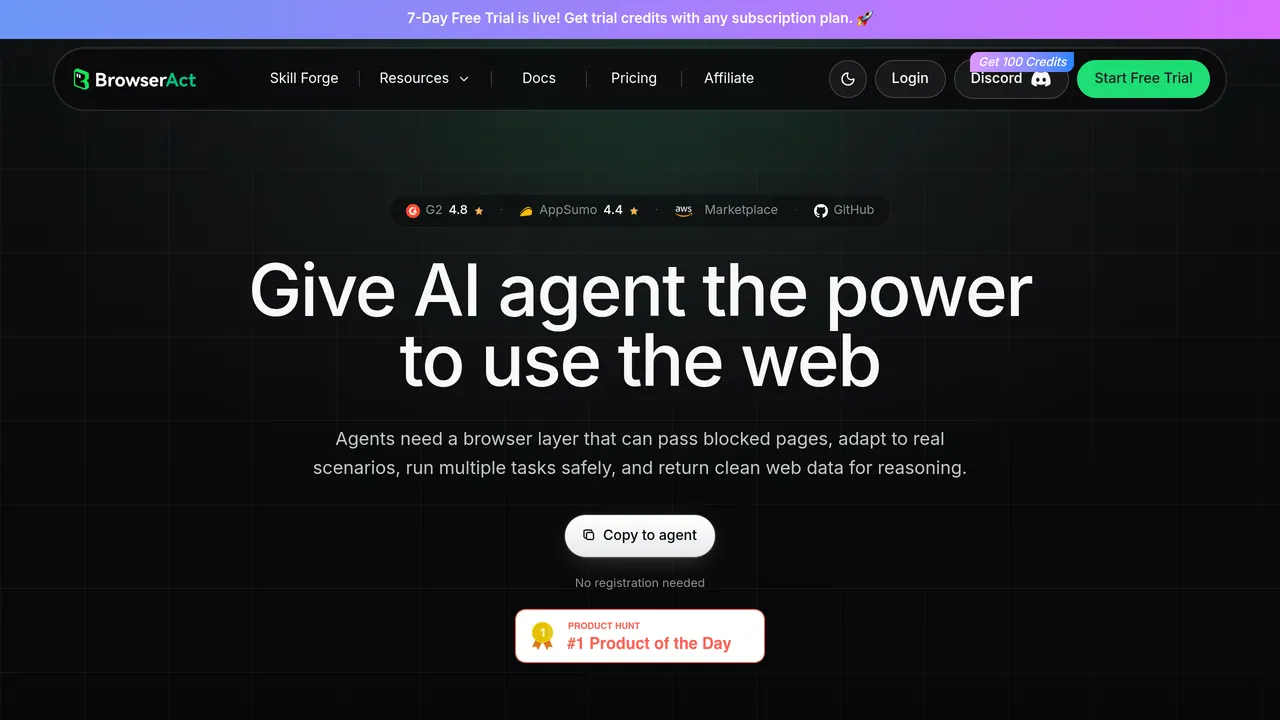
BrowserAct
No-code AI web scraper that builds reusable Bots in the cloud, plus a CLI that gives local agents a browser.
BrowserAct is a no-code AI web scraping platform: you describe the data, its AI agent builds a tested Bot that runs in BrowserAct's cloud browsers, and results go out as CSV, JSON, APIs, webhooks, Make, n8n or Zapier. Free gives 200 credits on sign-up; Basic is $13 a month billed yearly or $16 billed monthly.
About BrowserAct
A Bot-Agent uses AI to understand a website and build an adaptive Bot; building takes more credits, and each run usually costs a small fraction of that. A Bot Workflow instead follows predefined browser steps at 3 credits per step. Bots run on a schedule around the clock in BrowserAct's cloud, can start each run in a fresh browser or keep a signed-in profile, and BrowserAct says they find the data again on their own when a site's layout changes.
Runs handle CAPTCHAs such as reCAPTCHA, Turnstile and DataDome, use residential proxies, and give each Chromium session a consistent device identity of 30+ fingerprint attributes. Bots can monitor prices, stock and listings on a schedule with email alerts on changes, and a published workflow becomes a REST API endpoint that returns JSON, CSV, XML or Markdown by webhook or polling.
The Agent CLI gives your own agent commands to control a browser on your machine, with no BrowserAct runtime fee. An MCP server lets compatible AI clients discover and run published cloud Bots; the integrations page lists clients such as Claude Code, Codex and Cursor and says they share that MCP server or the Agent CLI rather than having separate native integrations.
Basic includes 10,000 monthly credits and 10 simultaneous tasks, Essential 50,000 and 20, and Advanced 100,000 and 40. Billed yearly they cost $13, $56 and $96 a month ($156, $672 and $1,152 a year); billed monthly, $16, $70 and $120. A simple Bot is estimated at 300–500 credits to build and 10–20 credits per run.
Sources: browseract.com, /pricing, /integrations and /data-api, read 2026-10-26
BrowserAct pros and cons
Pros
- Local execution through the CLI has no runtime charge, and your own proxies can be connected to local browser profiles without using BrowserAct's proxy credits.
- Eligible new users can try a paid plan free for 7 days, on top of the Free plan's 200 credits and 2 Agent builds.
- Human Interaction nodes pause a workflow at a verification step so an operator can take over, then the run continues automatically.
Cons
- The 24/7 cloud browser runtime and the built-in dynamic proxy are free only for a limited time, according to the pricing page.
- Everything draws on one credit balance; when it reaches zero, the current step finishes, then execution and proxy connections pause.
- Build costs vary by site: a complex Bot is estimated at 800–1,500 credits to build, and BrowserAct says actual usage may vary.
- Some listed connections run through third parties: the Google Sheets example uses Make rather than a direct integration.
Tagged
- Web-based
- Agentic Mode
BrowserAct alternatives
The closest alternatives to BrowserAct.
Related reading
Featured on Vibedonalds
Own BrowserAct? Add this badge to your site to show you’re listed — and link back to your profile here.

<a href="https://vibedonalds.com/tools/browseract" target="_blank" rel="noopener nofollow">
  <img src="https://vibedonalds.com/badge/featured-on-vibedonalds.svg" alt="BrowserAct — Featured on Vibedonalds" width="240" height="60" loading="lazy" />
</a>Frequently asked questions
- What is BrowserAct?
- BrowserAct is a no-code AI web scraper that builds reusable Bots in the cloud, plus a CLI that gives local agents a browser.
- Is BrowserAct free?
- BrowserAct offers a free tier and paid plans with higher limits or premium features.
- What platforms does BrowserAct support?
- BrowserAct's own site lists it for CLI.
- What are the alternatives to BrowserAct?
- The closest alternatives to BrowserAct are Bardeen, Moli by Lexmount.
- What are the downsides of BrowserAct?
- The 24/7 cloud browser runtime and the built-in dynamic proxy are free only for a limited time, according to the pricing page. Everything draws on one credit balance; when it reaches zero, the current step finishes, then execution and proxy connections pause. Build costs vary by site: a complex Bot is estimated at 800–1,500 credits to build, and BrowserAct says actual usage may vary. Some listed connections run through third parties: the Google Sheets example uses Make rather than a direct integration.
- How much does BrowserAct cost?
- Free is $0 with 200 credits on sign-up and 2 Agent builds. Basic, Essential and Advanced cost $13, $56 and $96 a month billed yearly, or $16, $70 and $120 billed monthly, for 10,000, 50,000 and 100,000 monthly credits. Custom plans are available on request.
- Can I try BrowserAct for free?
- The Free plan includes signup credits and an Agent build to create and test a first Bot, and eligible new users can also try a paid plan free for 7 days.
- Does BrowserAct have an API?
- A published workflow becomes a REST API endpoint that you call with its workflow ID and input parameters, using a bearer API key. Results arrive by webhook, or you poll get-task-status and fetch them with get-task.
- What is the difference between BrowserAct Cloud and the Local CLI?
- Cloud SaaS runs Bots 24/7 in BrowserAct-managed cloud browsers and can include managed proxies. The Local CLI runs on your own machine with no runtime fee, and credits are used only for optional BrowserAct browser or proxy add-ons.
- Does BrowserAct work with n8n, Make or Zapier?
- Make, n8n and Zapier can pass cloud Bot results to other apps, and webhooks notify your endpoint about results or status changes.