The Future of Marketing for People Who Build with AI (Do This Before 2027)
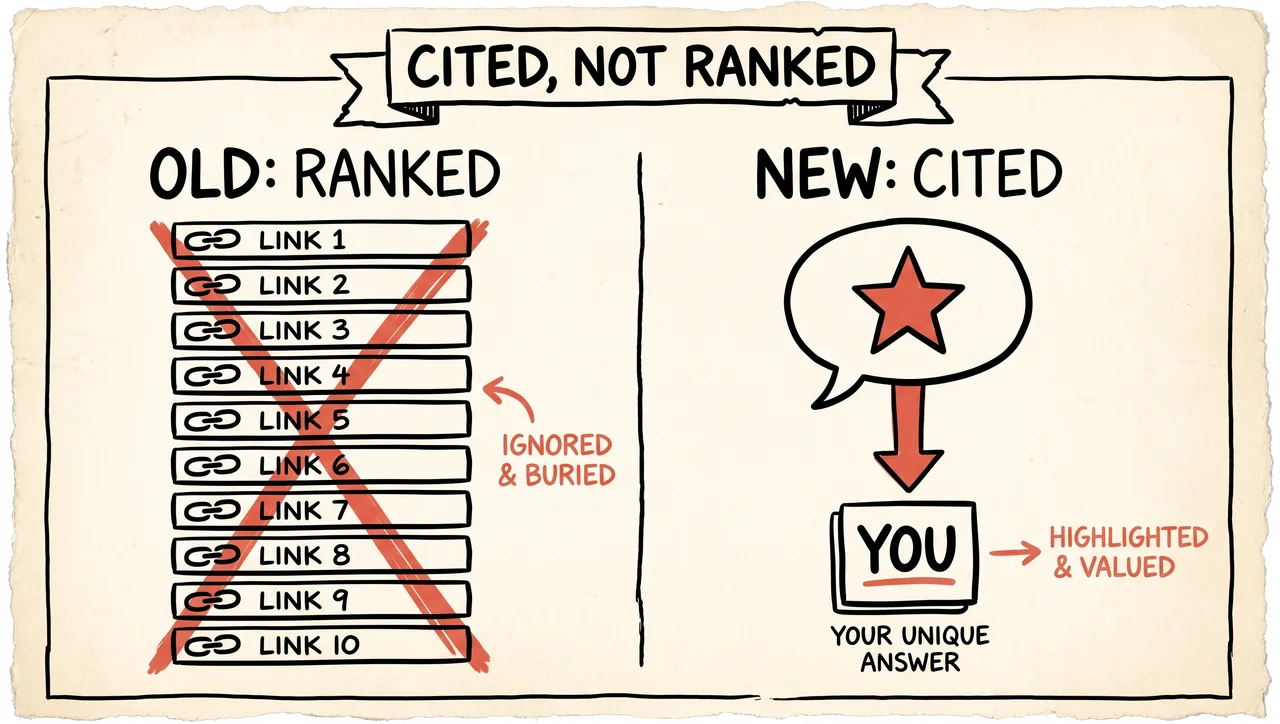
When AI makes building a product trivial and floods the web with generic content, marketing inverts: distribution becomes the moat, and distribution increasingly means being the source AI answer engines and buying agents cite and recommend. The durable move before 2027 is to engineer your product to be machine-discoverable and corroborated from day one — even at zero domain authority. Strong in the future means cited, not ranked.
Almost every 'future of marketing' guide is written for CMOs and brand teams. This one is for the person who shipped a product over a weekend with AI and then hit the wall everyone hits: building was the easy part. Here is what is actually changing in how products get found, what still works, and the specific things to do now so AI-era discovery works for you instead of around you.
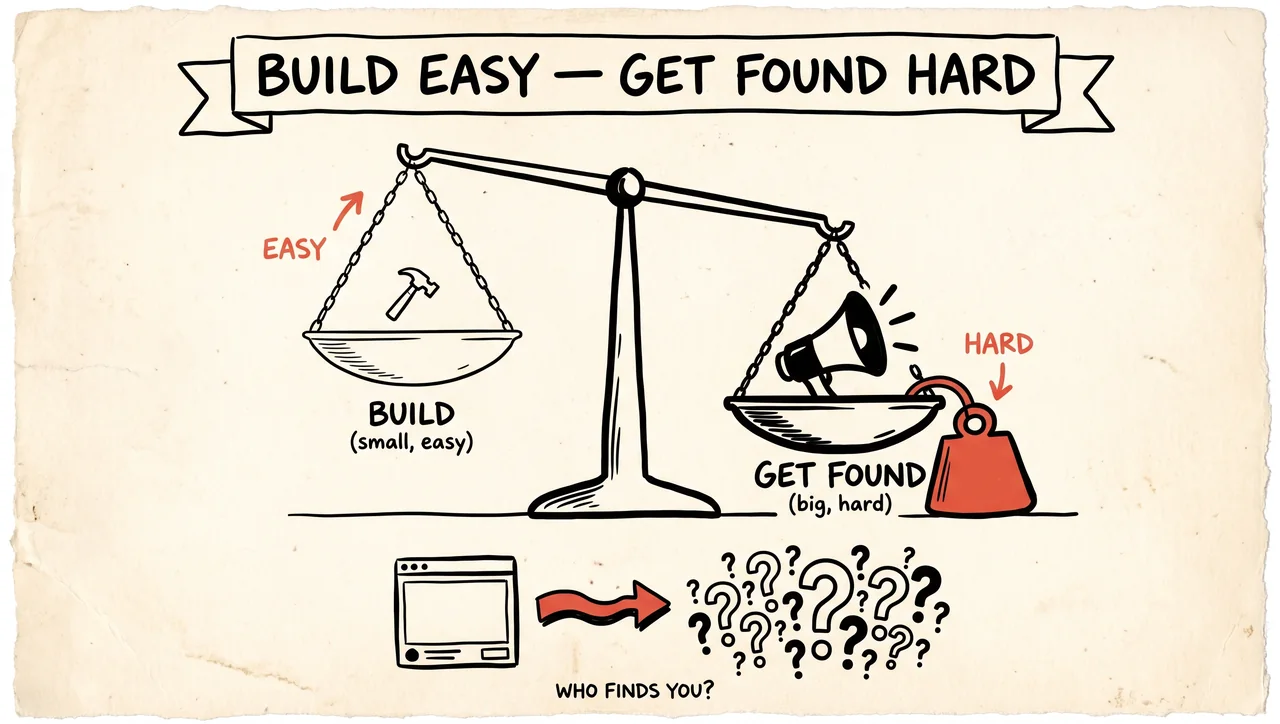
Why has marketing suddenly inverted?
Short version: the bottleneck moved. For two decades the hard part of a software business was building the thing, and distribution was a roughly solved funnel of SEO, ads, and social. AI flipped both. Building is now radically faster — many non-technical founders ship a working app in days — so everyone is shipping, and the web is filling with near-identical AI-written pages. When the supply of both 'product' and 'content' explodes, the scarce thing is no longer creation. It is attention and trust. Distribution becomes the moat.
At the same time, the surface where people discover things is changing under your feet. OpenAI said ChatGPT had more than 700 million weekly users by September 2025. And Pew Research found that when Google shows an AI summary, people click a traditional result on just 8% of those visits versus 15% without one — and the AI summary's own links get clicked only about 1% of the time (Pew Research Center, July 2025). More and more, the answer is the destination, and the only question that matters is whether you are the source inside it. That is the whole thesis: in the AI era, strong marketing means being cited, not just ranked.
What do the numbers say about AI and discovery?
A snapshot of where AI-driven discovery actually is. Every figure here is tied to a primary or named source — because in this market most of the numbers that circulate are not.
- 01ChatGPT reached about 700 million weekly users by September 2025 (OpenAI).
- 02Google's AI Overviews reached 1.5 billion monthly users by April 2025 (Alphabet Q1 2025 earnings).
- 03Perplexity processed roughly 780 million queries in May 2025 — about 30 million a day (Perplexity, June 2025).
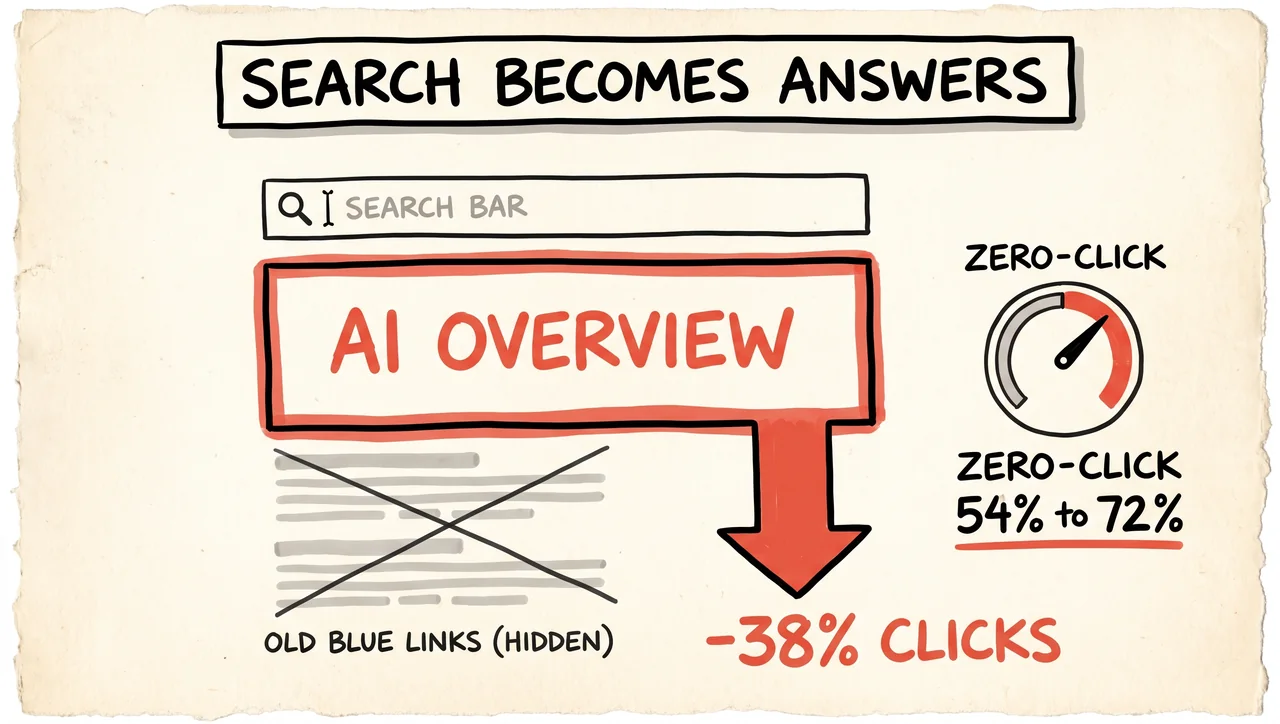
- 04When an AI summary appears on Google, people click a traditional result on 8% of visits versus 15% without one — and the summary's own links are clicked about 1% of the time (Pew Research Center, July 2025).
- 05A 2026 study found AI Overviews appeared on 51.5% of the representative real-user queries it tested (Grossman et al., April 2026).
- 06Exposure to AI Overviews cut daily traffic to English Wikipedia articles by about 15% (Khosravi and Yoganarasimhan, February 2026).
- 07GEO techniques lifted a source's visibility inside AI answers by up to 40% — and up to 37% on Perplexity — in the foundational GEO study (Aggarwal et al., KDD 2024).
- 08AI-search referrals to US retail sites jumped about 1,300% over the 2024 holiday season, and those visitors browsed 12% more pages with a 23% lower bounce rate (Adobe Analytics, March 2025).
- 09Gartner expects more than 40% of agentic-AI projects to be canceled by the end of 2027 (Gartner, June 2025).
Is search becoming answers?
Yes, and fast. Google's AI Overviews and AI Mode now summarize above and alongside the links — and Google said AI Overviews reached 1.5 billion monthly users by April 2025 (Alphabet Q1 2025 earnings). A 2026 study found they appeared on 51.5% of the representative real-user queries it tested (Grossman et al.), and exposure to them cut daily traffic to English Wikipedia articles by about 15% (Khosravi and Yoganarasimhan, February 2026). Classic SEO and 'answer engine optimization' have split: AI citations don't perfectly mirror organic rankings, so a newer page can earn a citation by being the clearest, best-sourced answer even when it isn't the number-one result.
Are humans becoming the agents?
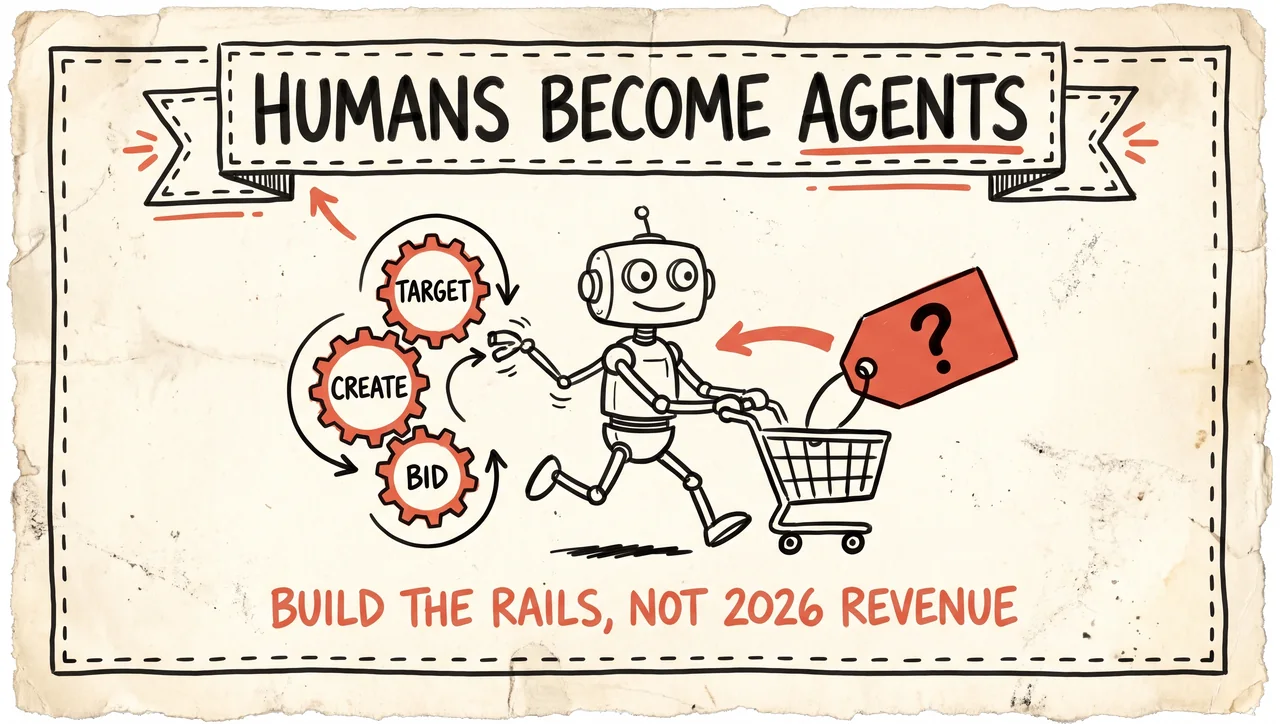
Increasingly the software is. Marketers have moved fast from using AI to draft copy toward letting it run whole loops — targeting, creative variants, and bidding — with a human approving the output, and the shift is measurable: in one large usage dataset, AI-agent activity grew more than fivefold in the first half of 2026 (Johnston et al., 2026). The next step is agents that buy: OpenAI launched Instant Checkout in ChatGPT in September 2025 (built with Stripe, starting with Etsy and more than a million Shopify merchants slated to follow), and Perplexity added a PayPal-powered buy option later that year. Adobe found AI-search referrals to US retail sites jumped about 1,300% over the 2024 holiday season — but from a small base (Adobe Analytics, 2025). Treat 2026 as the year to build the rails, not to bank the revenue: in-chat checkout is still early, merchant adoption is thin, and the standards are unsettled. The signal is real; the channel is not yet mature.
Is content becoming a commodity?
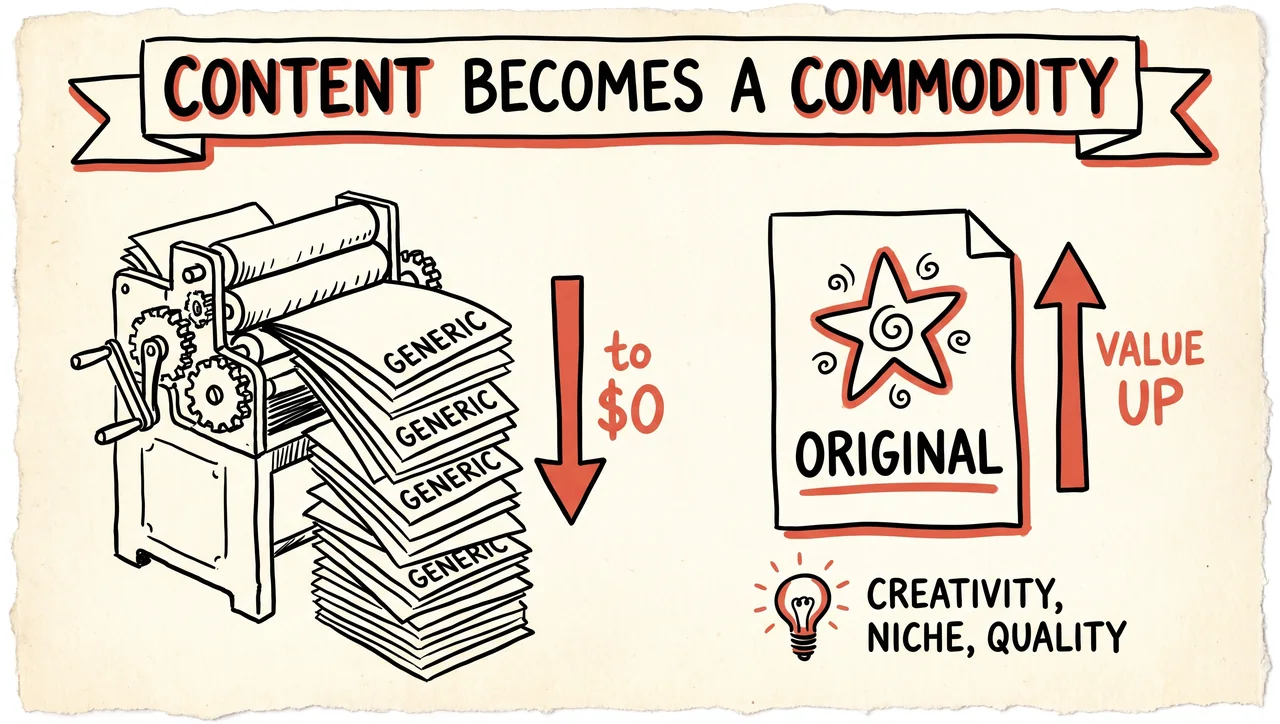
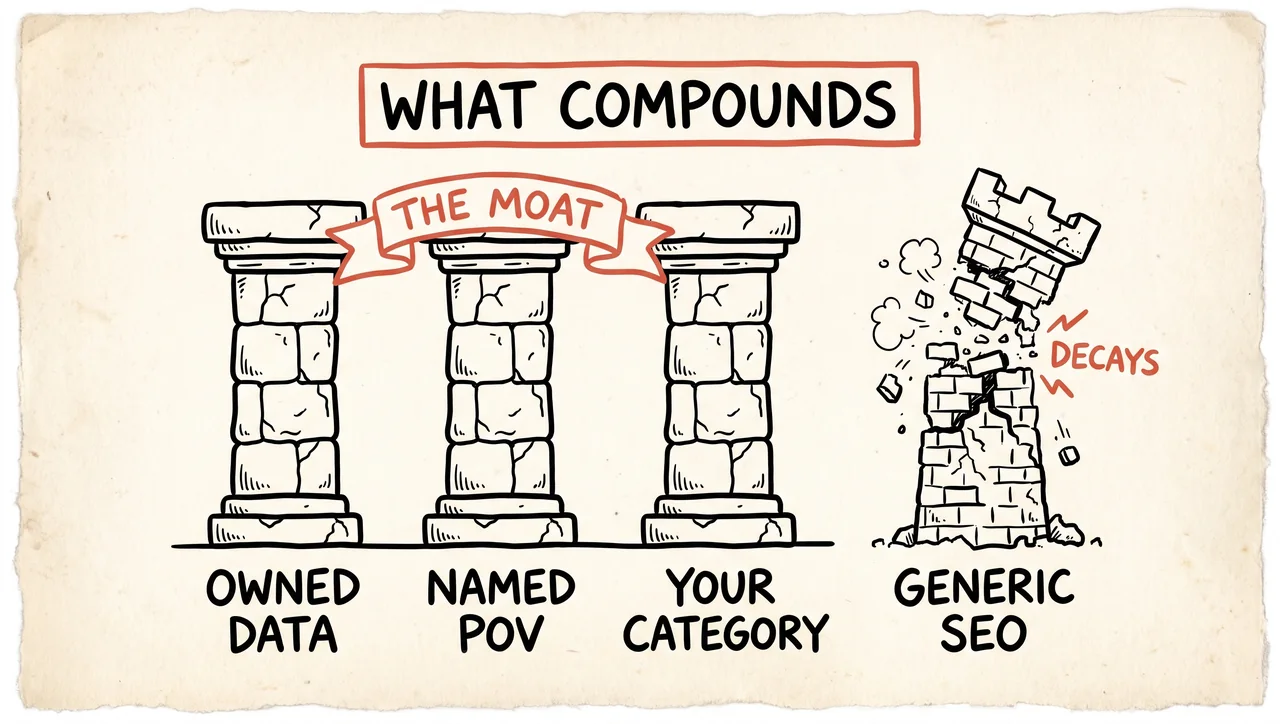
Completely. When anyone can generate a competent blog post in seconds, competent is worthless — and the flood is real: one analysis of Common Crawl data found AI-written articles have made up roughly half of all new online articles for over a year (Graphite, 2026). Generic SEO content now decays toward zero, and the only marketing assets that appreciate are the ones AI cannot mass-produce: original data, a named point of view, and being the recognized entity in your niche.
What still works: do speed, volume, and empathy beat budget?
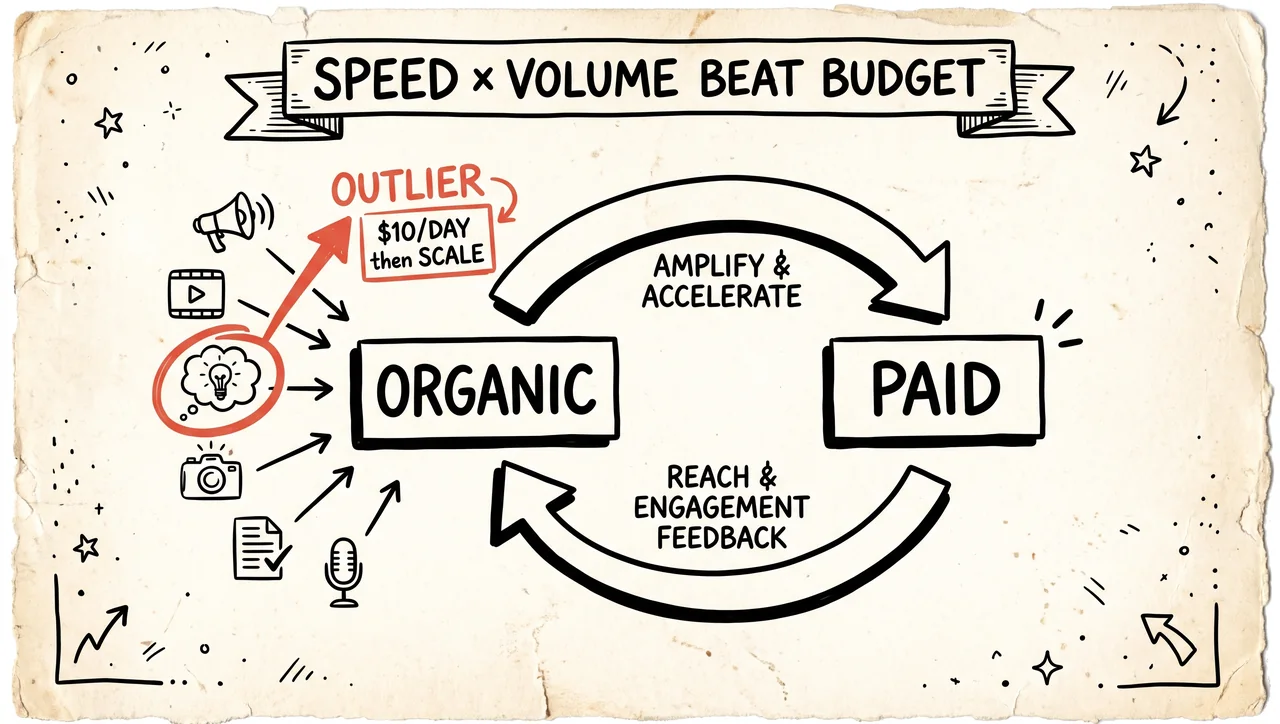
None of this kills the fundamentals — it sharpens them. The most useful frame from operators running modern brands is to treat your product like a mini media company: organic content and paid ads are not separate teams, they are one loop. You make a lot of cheap content, find the few pieces that beat your baseline, and put money behind those. The edge is no longer budget or polish; it is speed and volume. A bias for action — shipping a test this week instead of planning for a quarter — beats a perfect brand.
For a solo or small builder that is liberating, because the same loop runs on almost nothing. You can validate a concept with free organic video — short clips on TikTok and Instagram can pick up views from a standing start — and only then port the winners into paid, starting at a few dollars a day. You do not have to be the founder on camera; a credible expert or a friendly face reading a tight script often works better. The real unlock for a three-person team is scale: many hooks, many variants, many small bets, then pour distribution behind whatever moves.
And the point of a viral hit is not the views — it is raising the floor, widening your audience so the algorithm later serves your actual converting content to the right people. The tactics for that deserve their own playbooks, which we have written up separately.
- How to Make Your App Go Viral with UGC
Why views alone get you nothing, and the test-and-scale loop that turns content into installs.
- How to Get Your First Users for a Vibe-Coded App
The zero-to-first-5,000 distribution playbook for a product nobody has heard of yet.
How do you get found when AI is the front door?
This is the part the CMO-facing guides skip, and it is the most important part for you. AI answer engines don't just rank pages; they retrieve sources, synthesize an answer, and cite the ones they trust — so citation visibility is not the same as classic rank. Two things decide whether that source is you: can a model extract a clean claim from your page, and do several independent places say the same thing about you. Authority helps, but it is not the gate — which is exactly why a low-authority product can still get cited.
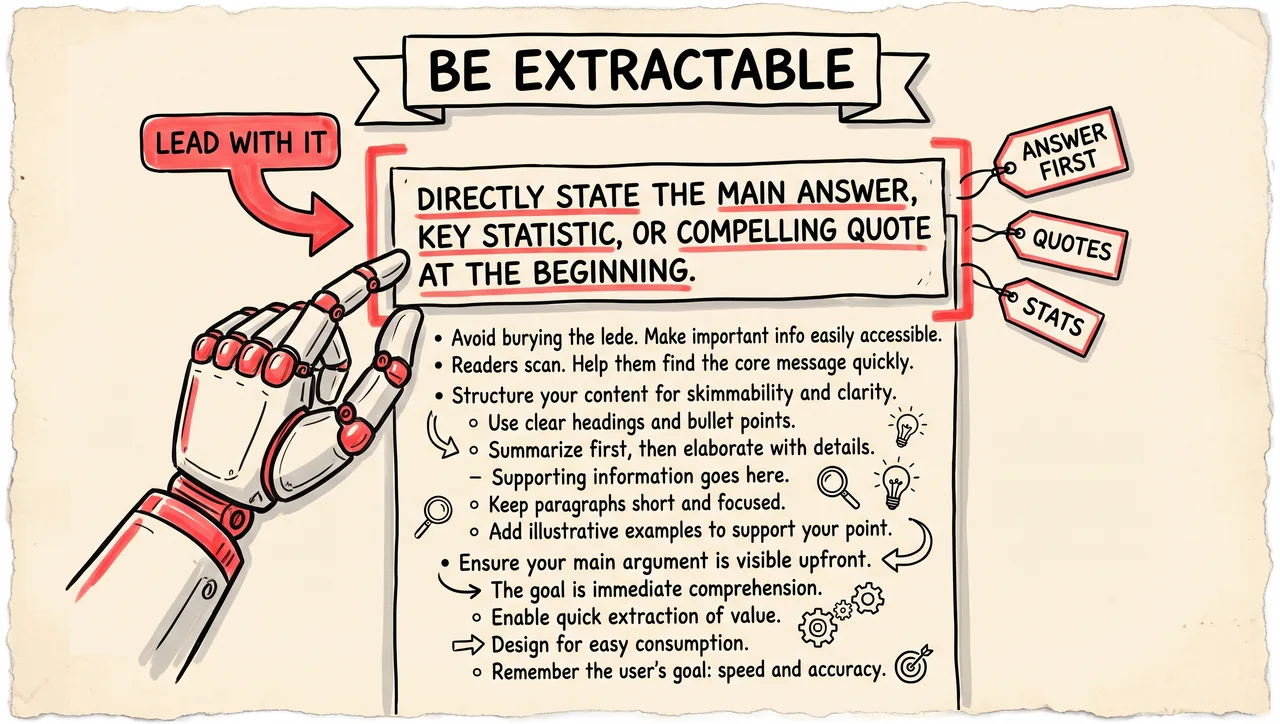
Aggarwal et al.'s GEO study (KDD 2024), testing nine tactics across about 10,000 queries, found the moves that lift a source's visibility in generated answers most are not keywords — they are adding citations, quotations, and statistics, which improved a source's visibility by up to 40% on their benchmark — and up to 37% on Perplexity. So lead with the answer, put real numbers and real sources in, and shape your headings as the questions people actually ask.
Then get corroborated. One landing page is not enough; engines get confident when a directory, a Reddit thread, a YouTube demo's transcript, and your own site all describe your product the same way. This is the real reason to be listed where these engines crawl — a directory listing is not a backlink play, it is a corroboration play. We go deep on the mechanics in two companion guides.
One caution: ignore anyone selling a single 'AEO hack.' Google has not documented llms.txt as a supported Search signal, and each engine's citation behavior keeps shifting. The durable version is not a trick — it is genuinely being the clearest, most corroborated answer to a question people ask.
- How to Get Your AI App Cited by ChatGPT and Perplexity
The maker's version of GEO: the concrete things that make engines quote your product instead of a competitor.
- Where to List Your AI App
The directories and review sites AI engines actually crawl — your corroboration surface.
What is the moat once content is free?
If anyone can generate the content, the moat is everything that cannot be generated. Three things compound while generic content decays.
Owned data and audience. Third-party cookies did not die on the schedule everyone feared — in 2025 Google dropped its plan to fully deprecate them in Chrome — but the direction is set, and AI personalization runs on data you own. First-party data (how people actually use your product) and zero-party data (what they tell you directly through quizzes, preferences, and a community) is fuel competitors cannot copy. Turn your best customers into advocates; that flywheel is both your distribution and your proof.
A named point of view. AI flattens anonymous content into sameness, which makes a real author with a real opinion scarce and valuable. Publish under a name, take positions, and put original data into the world — the one thing a model cannot synthesize is a number only you have.
Your category, claimed early. Answer engines tend to lock onto the sources they already trust for a topic, so late entrants compete for scarce citation slots. If you are defining a small niche, the move is to become its referenced source now, while the slot is still open.
Do this before 2027: the builder's operating system
Fuse the two layers — win attention with the content loop, win discovery by being the cited, corroborated answer — into one routine. In order:
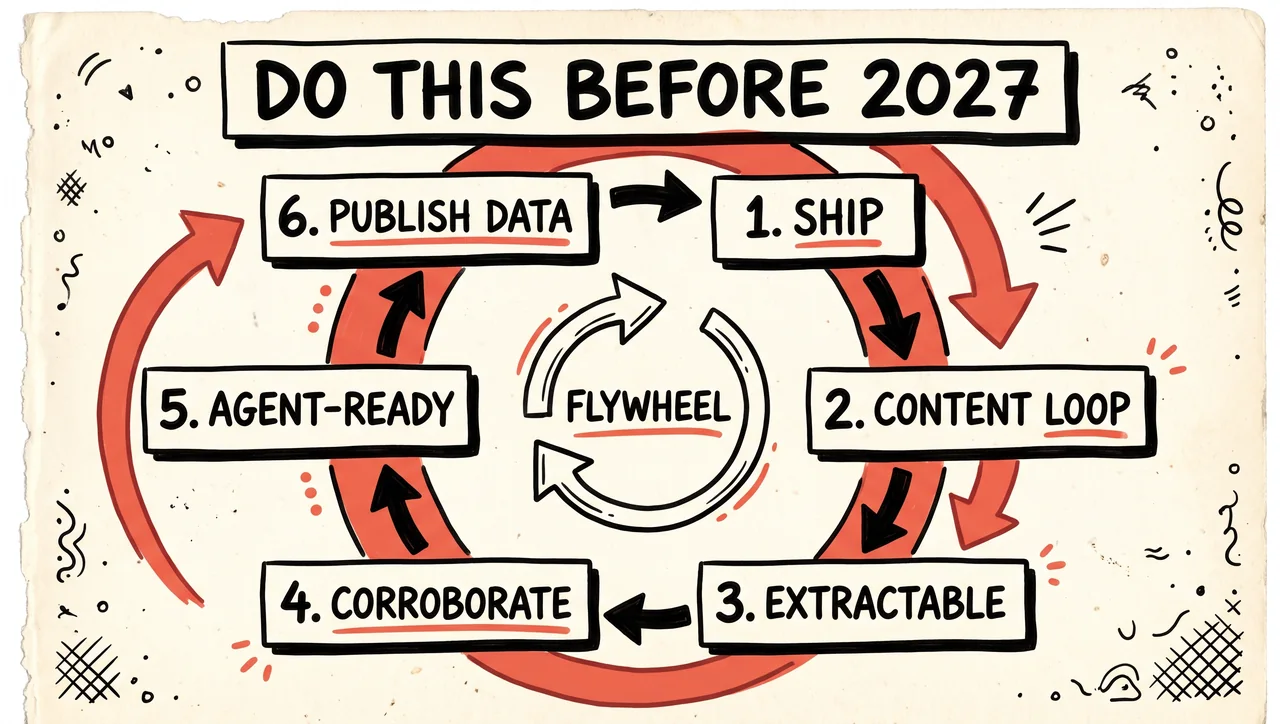
- 01Ship and instrument. Wire up first-party analytics from day one; owned data is the asset everything else compounds on.
- 02Run the content loop. Make cheap organic video, find the outliers, put $10/day behind the winners. Volume over polish.
- 03Make every key page extractable. Answer first, question-shaped headings, real numbers, plus FAQ and structured data so a model can lift a clean passage.
- 04Get corroborated. Use the same one-line description of your product across a directory listing, a Reddit thread, a short demo video, and your own site.
- 05Be agent-ready. Give your product a clean structured feed and schema so the buying agents now forming can find and recommend it — infrastructure, not a 2026 revenue plan.
- 06Use AI as your team, keep judgment human. Draft landing pages and copy with models; keep the strategy, taste, and point of view yours. The teams that win pair AI speed with human judgment.
- 07Publish your own data. Once a quarter, ship a number or finding only you have. It is the most citable thing you can make.
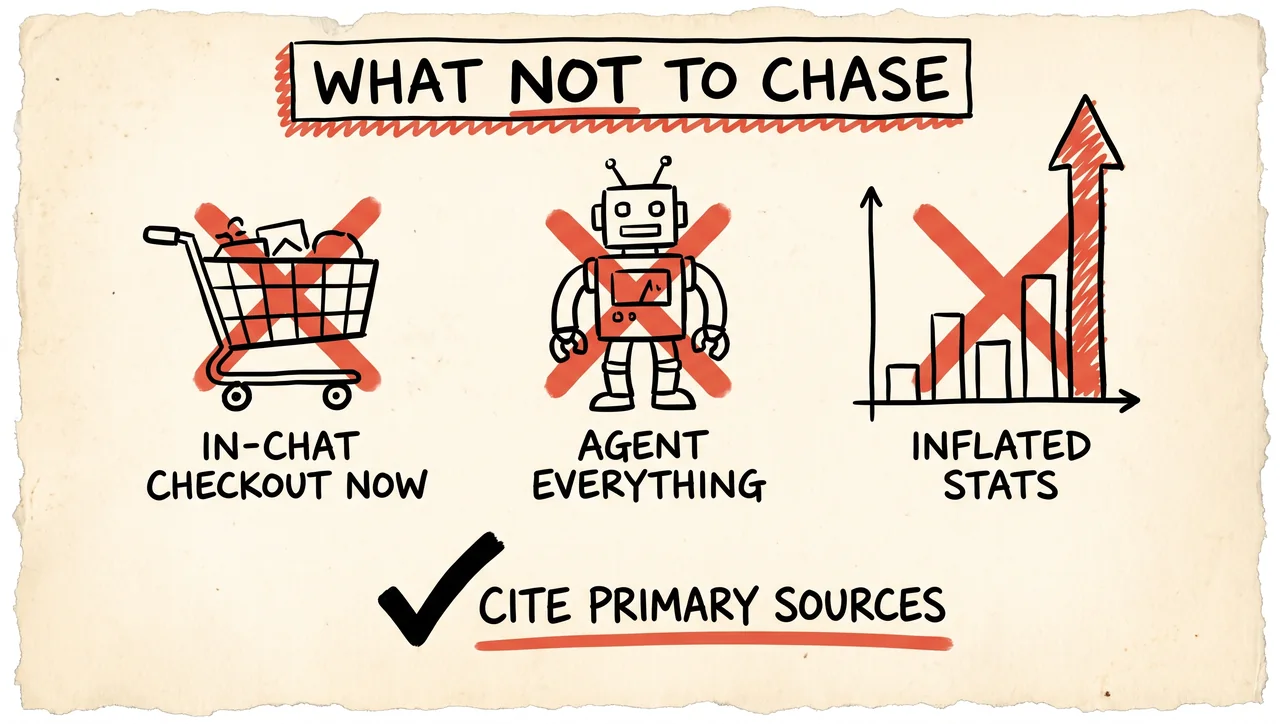
What should you not chase?
Three hype traps to skip. First, in-chat purchase as a 2026 revenue line — the rails are real but immature, with thin merchant adoption and unsettled standards so far. Build the structured feed; do not reforecast revenue around it yet.
Second, agent-everything. Gartner expects more than 40% of agentic-AI projects to be canceled by the end of 2027 on rising costs and unclear value. Agents pay off when they sit on clean, unified data with a human in the loop — not as a demo.
Third, the stat inflation that surrounds this topic. Inflated figures — '900% growth', 'AI Overviews on most searches' — get passed around from low-quality roundups and contradict what has actually been measured. Cite primary sources, and when you do not have a solid number, say so. In a market drowning in confident nonsense, being the trustworthy one is itself a distribution strategy.
Frequently asked questions
- Does marketing still matter when AI builds the product?
- More than ever. When building is trivial and content is commoditized, distribution becomes the moat. The work shifts from making the product to making it discoverable and trusted — being the source AI engines and agents cite and recommend.
- How do I get a new product cited by AI with no backlinks?
- Be extractable and corroborated. Publish answer-first pages with real numbers and question-shaped headings, then get the same description of your product onto a directory, a Reddit thread, and a demo video. Aggarwal et al.'s GEO research (KDD 2024) found citations, quotations, and statistics outperformed keyword tweaks for visibility in AI answers — so being clearly citable matters more than domain age.
- Is SEO dead — what is the difference between SEO, AEO, and GEO?
- SEO is not dead, but it is no longer enough. SEO optimizes to rank in a list of links; AEO and GEO optimize to be the cited source inside an AI answer. Because AI citations do not perfectly mirror rankings, a newer page can be cited for being a clear, well-sourced answer — so optimize for both: stay crawlable and structured, and write answer-first and corroborated.
- How do brands get discovered by AI buying agents?
- Through structured product data the agents can read. OpenAI and Perplexity launched in-chat purchase in late 2025 on emerging commerce protocols. Treat 2026 as infrastructure: give your product a clean feed and schema so it is selectable, but do not bank revenue on in-chat checkout yet — it is early, with thin merchant adoption so far.
- What marketing skills will be valuable in five years?
- Judgment, a point of view, and the ability to make assets AI cannot: original data, a trusted named author, and a clearly-owned niche. The mechanical work — drafting, bidding, variant-making — is going to agents; the human edge is taste, strategy, and trust. Our guide to future-proof skills for the AI era covers this in depth.