What Is an AI Agent Harness? The Runtime That Turns an LLM Into an Agent (2026)
A harness is the runtime wrapper that turns a bare language model into an agent — the layer that runs tools, holds memory, assembles context, and enforces limits. The model does the reasoning; the harness does everything the model can't do on its own. It's the part that decides whether you shipped a chatbot or a real agent — and it's why the same model feels brilliant in one tool and useless in another.
If you've used Claude Code, Cursor, or any AI tool that does real work over many steps, you've used a harness — you just didn't see it. This is the plain-English version for makers: what a harness is, the four parts every one has, and why the harness, not the model, is the thing worth understanding. The framing follows Nexu's open Harness Engineering Guide; the angle is ours — what it means when you're the one building the agent.
What is an AI agent harness?
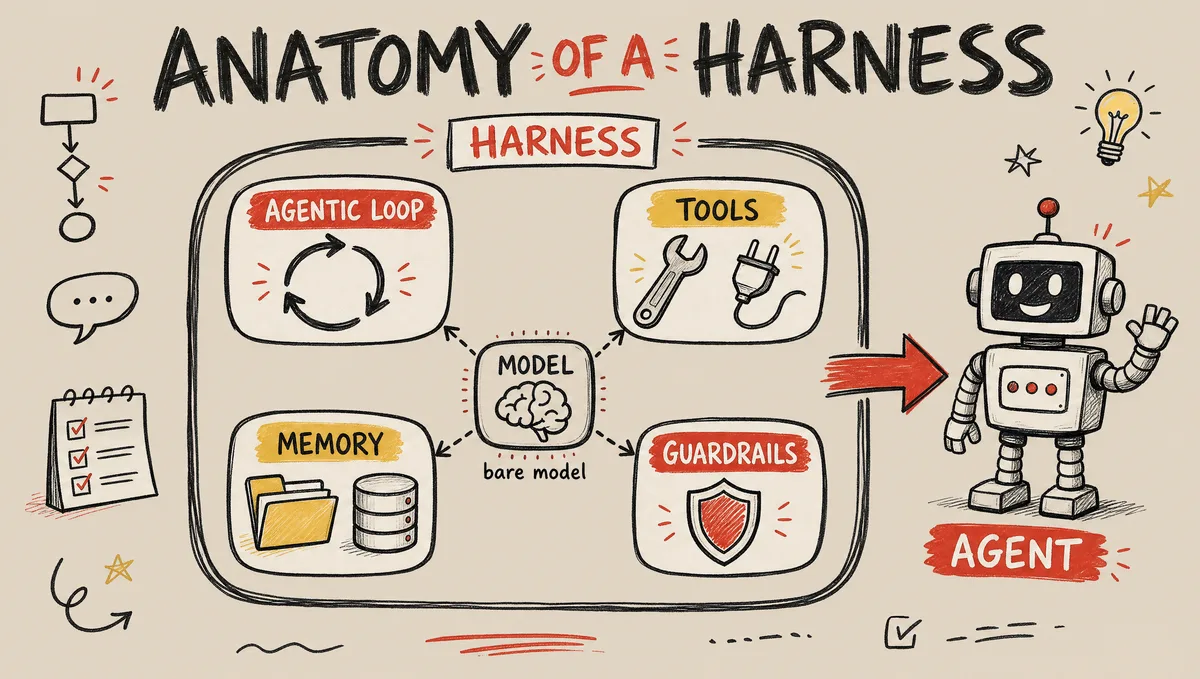
A harness is the runtime wrapper that turns a bare language model into an agent — a system that can look at its situation, decide what to do, and take action over many steps until a task is done. The model supplies the reasoning. The harness supplies everything the model can't do alone: running tools, remembering things across sessions, deciding what to put in front of the model, and stopping it from doing something it shouldn't.
Strip the harness away and you have a chatbot that can call a function. Add it and you have something that can open a codebase, read the right files, fix a bug across several of them, run the tests, and commit — without a human driving each step. The model didn't change. The wrapper around it did.
Every harness, no matter who built it, is made of the same four parts: an agentic loop, a tool system, memory and context, and guardrails. The rest of this guide walks each one.
- Harness Engineering Guide (Nexu, open source)
The source for this framing — an MIT-licensed, code-first guide to building agent runtimes.
Why does the harness matter more than the model?
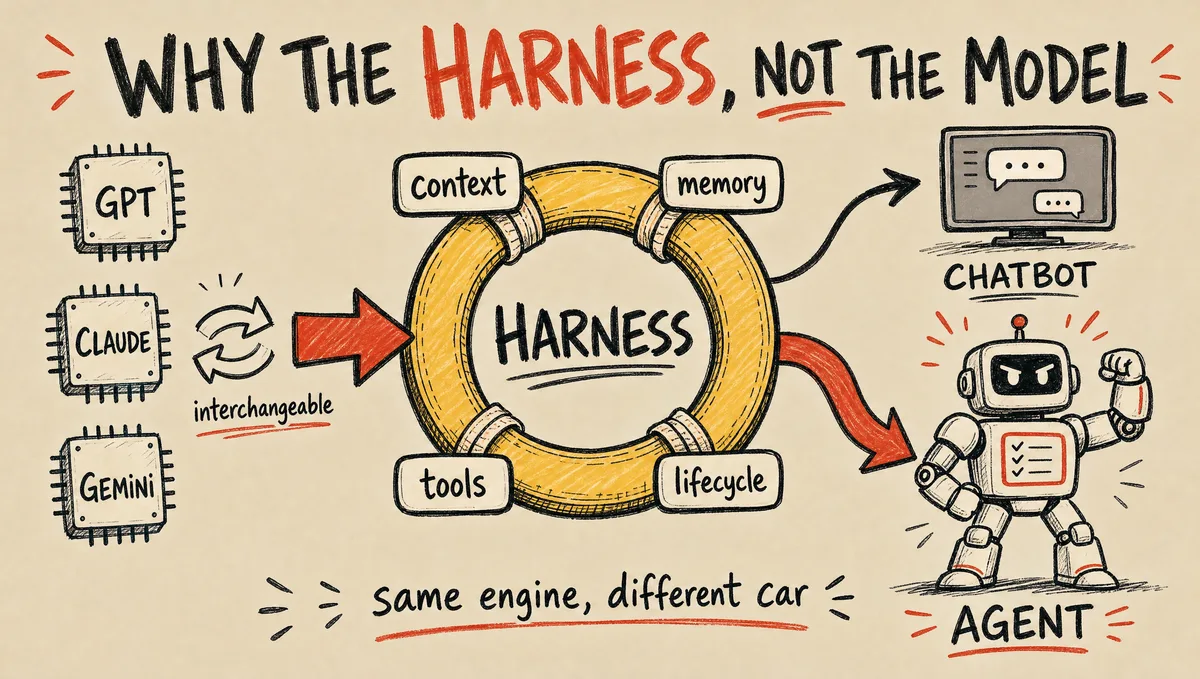
Because the models are converging and the harness isn't. GPT, Claude, and Gemini keep trading the lead, and swapping one for another is increasingly a config change. When the brain becomes a commodity, the thing that actually differentiates one agent from another is the engineering around it — how it manages context, what it remembers, which tools it has, and how its run is orchestrated. That's the harness, and that's where the real moat sits.
It's also the simplest explanation for a thing you've probably noticed: the same model feels sharp in one product and hopeless in another. The difference usually isn't the model — it's the harness. A good one feeds the model the right context at the right moment and gets out of the way; a bad one floods it with junk, forgets what happened two steps ago, and loops. Same engine, different car.
What's the difference between a 2023 'agent' and a real agent?
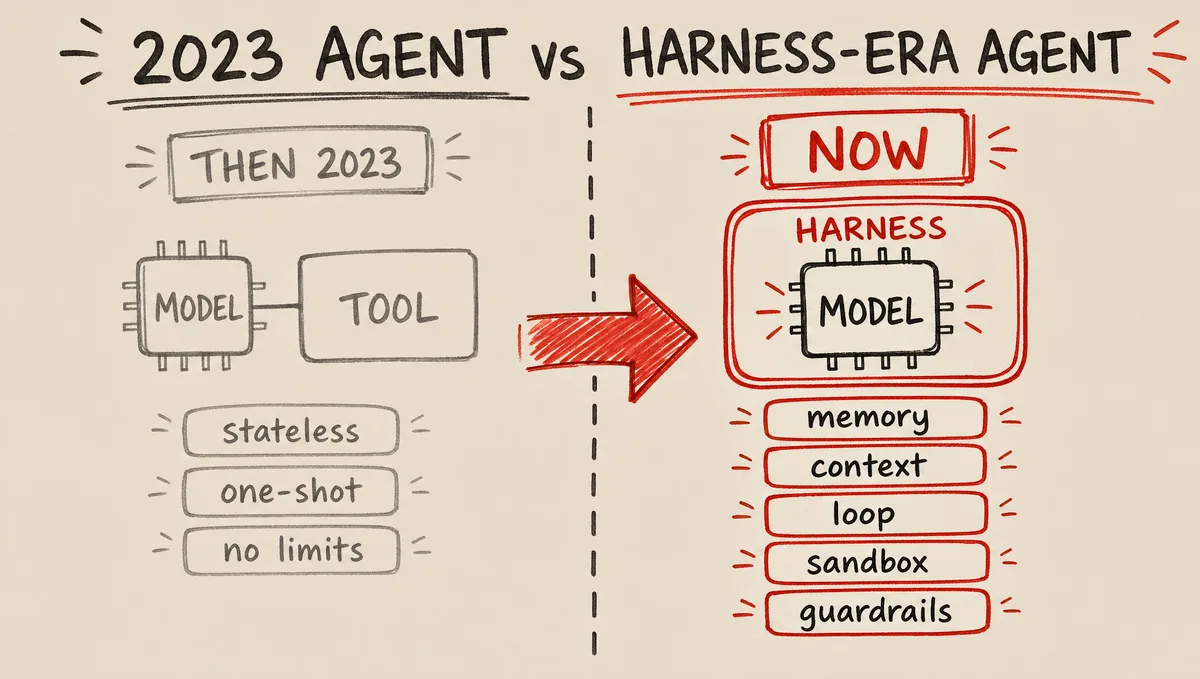
In 2023 'agent' usually meant a model plus a tool — give GPT a web-search function and call it an agent. It was stateless (forgot everything between calls), single-turn, and ran loose in your process with no real boundaries. Useful for a demo, fragile for real work.
The agents harness engineering targets are a different animal. They carry memory that persists across sessions, assemble their context on purpose instead of dumping everything in, run in a loop that can recover from errors, execute inside a sandbox, and operate behind a permission model. 'Model plus tools' was the seed; the harness is the rest of the plant. When people say agents finally got good in 2025–2026, this is what changed — not only the models, but the engineering wrapped around them.
What is the agentic loop?
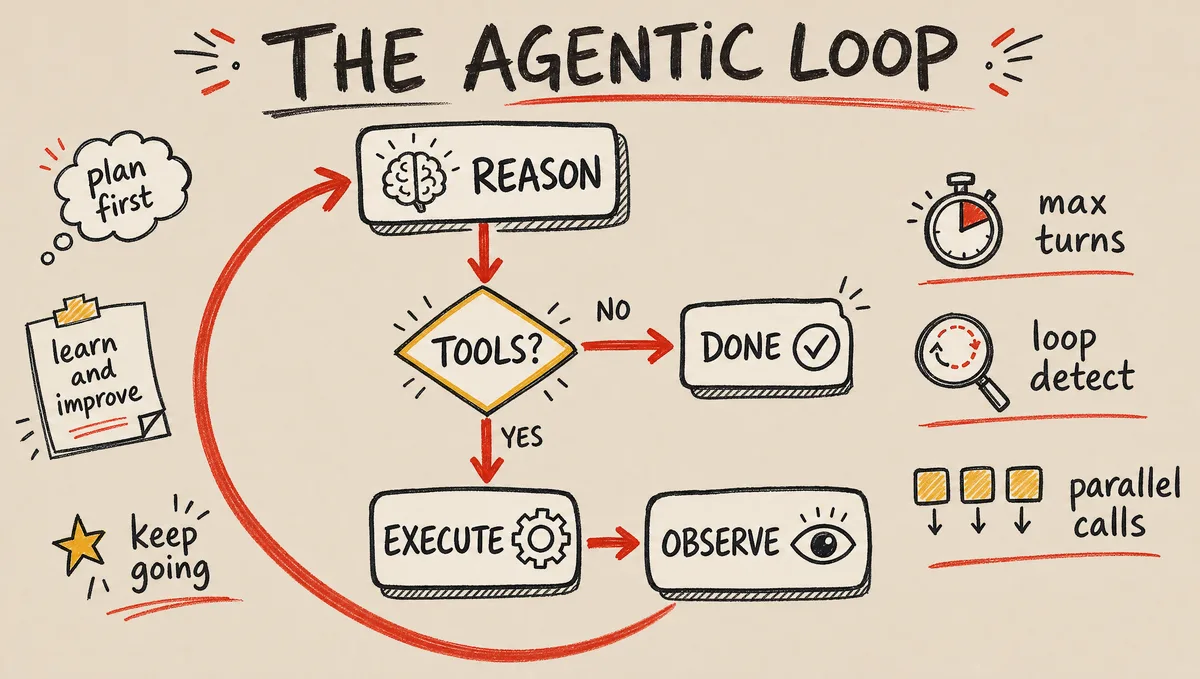
The agentic loop is the engine inside every agent: reason, act, observe, repeat. The model thinks and optionally asks to run one or more tools; the harness runs them and feeds the results back; the model looks at what came back and decides whether it needs more or it's done. It's the same idea as the older ReAct pattern (reason + act), run on a loop instead of once.
That's the part that separates an agent from a single tool call. A one-shot call ends the moment the function returns. A loop keeps going — read a file, realize you need another, read that, run the tests, see them fail, fix, re-run — until the model produces a final answer with no tool call left to make.
The loop itself is a dozen lines. What makes it production-grade is the edges. A hard turn limit (say 25) so a confused model can't loop forever burning tokens. Loop detection for when it calls the same tool with the same input over and over. A token budget that triggers context compression instead of crashing. Parallel tool calls so reading three files happens at once, not one after another. Those guardrails are most of the engineering — the happy path is easy; the failure modes are the job.
What are the four parts of a harness?
Every harness decomposes into the same four subsystems. Once you can name them, you can debug almost any agent — because when an agent misbehaves, it's nearly always one of these four that's missing or weak.
- How AI agent memory works (Claude Code)
A maker's deep dive on the memory-and-context part — the layer most home-grown agents skip.
- 01Agentic loop — the reason → act → observe cycle, plus the exit conditions that keep it from running forever. This is the orchestration: when to call a tool, when to stop, what to do when a tool fails.
- 02Tool system — the registry of what the agent can actually do: read and write files, run a shell, search the web, call an API. Tools can be loaded up front, or pulled in on demand as skills (the pattern behind MCP). A tool is only as good as its description — the model picks tools by reading them.
- 03Memory and context — what the model is allowed to see. Three layers: context (what goes into this one API call), memory (what survives across sessions — a MEMORY.md, daily logs, learned preferences), and the session (the boundary of a single run). Get this wrong and the agent either forgets everything or drowns in irrelevant text.
- 04Guardrails — the limits. Permissions on what the agent may touch, a sandbox so a bad command can't wreck the host, and defenses against prompt injection sneaking instructions in through a file or web page. This is the difference between an agent you'd let near production and one you wouldn't.
Harness vs. framework: do you need LangChain?
A framework like LangChain or CrewAI hands you pre-built abstractions — chains, agents, memory classes — so you can wire something together fast. A raw harness is the loop you write yourself, in plain code, with nothing hidden. The trade is the usual one: the framework gets you moving quickly, then the abstractions get in the way exactly when you need precise control over context and the loop.
Here's the part that reframes the question for most makers: the tools you already use are harnesses, not frameworks. Claude Code, Cursor, Codex, Cline, Aider — each is a hand-built harness tuned for coding. So the real choice usually isn't 'which framework do I adopt.' It's 'do I understand the harness inside the tool I already use well enough to push it harder' — and, when you build your own agent, whether you reach for a framework's training wheels or write the small loop yourself.
- The best vibe coding tools (the harnesses, ranked)
The coding harnesses makers actually use day to day — and what each one's wrapper does well.
Why this matters if you vibe-code
The moment you put an AI feature into your own app — a support agent, a research bot, a thing that drafts replies from your inbox — you're building a small harness, whether you call it that or not. And the four parts tell you exactly why it's misbehaving. Loops forever? You're missing an exit condition. Forgets what the user said? No memory layer. Did something it shouldn't? No guardrails. Great one minute, lost the next? Your context assembly is feeding it junk.
You almost certainly don't need to build a harness from scratch — that's a deep discipline of its own, and Nexu's guide goes far past what one article can. What you need is the map: name the four parts, know which one is failing, and reach for the right fix instead of blaming the model. That alone puts you ahead of most people shipping agents right now.
- Build an AI sales agent from your own chats
A concrete, end-to-end agent project — your first real harness, start to finish.
- Run agents, not just prompts
Why agent-building is one of the skills that compounds as the models improve.
- harness-guide.com
The full Harness Engineering Guide as a site — every part above, with runnable code.
- List your AI app on Vibedonalds
Free after a quick review — a niche, crawlable directory for vibe-coded and AI-built products.
Frequently asked questions
- What is an AI agent harness?
- It's the runtime wrapper that turns a bare language model into an agent — the software around the model that runs tools, holds memory across sessions, assembles context, and enforces limits. The model reasons; the harness does everything else. Without it you have a chatbot; with it you have an agent that acts over many steps.
- What's the difference between a harness and a framework?
- A framework (LangChain, CrewAI) gives you pre-built abstractions to assemble fast; a harness is the agent loop itself, often hand-written for full control. The tools you use — Claude Code, Cursor, Codex — are harnesses, not frameworks. Frameworks help you start; harnesses are what you eventually want when you need precise control.
- What is the agentic loop?
- The reason → act → observe cycle at the core of every agent. The model thinks, optionally calls tools, sees the results, and loops until it has a final answer with no tool call left to make. It's the ReAct pattern run repeatedly. The loop is simple; the exit conditions that stop it looping forever are the hard part.
- Is a harness the same as LangChain?
- No. LangChain is a framework — a library of abstractions you wire together. A harness is the runtime that actually drives the agent: the loop, the tool registry, memory, and guardrails. You can build a harness with a framework, but most production coding agents are hand-built harnesses precisely because they need control the framework hides.
- Why is the harness more important than the model?
- Because the models are commoditizing — GPT, Claude, and Gemini keep converging, and swapping them is nearly a config change. What differentiates one agent from another is the engineering around the model: context, memory, tools, and orchestration. That's the harness, and it's why the same model feels great in one tool and useless in another.
- Do I need to build my own harness?
- Usually not from scratch. For coding, mature harnesses like Claude Code already exist. But the moment you add an AI feature to your own app, you're building a small one — so it pays to know the four parts (loop, tools, memory, guardrails) so you can tell which one is failing instead of blaming the model.