Zaro
Company knowledge layer that stores how your business runs as versioned, permissioned files for AI.
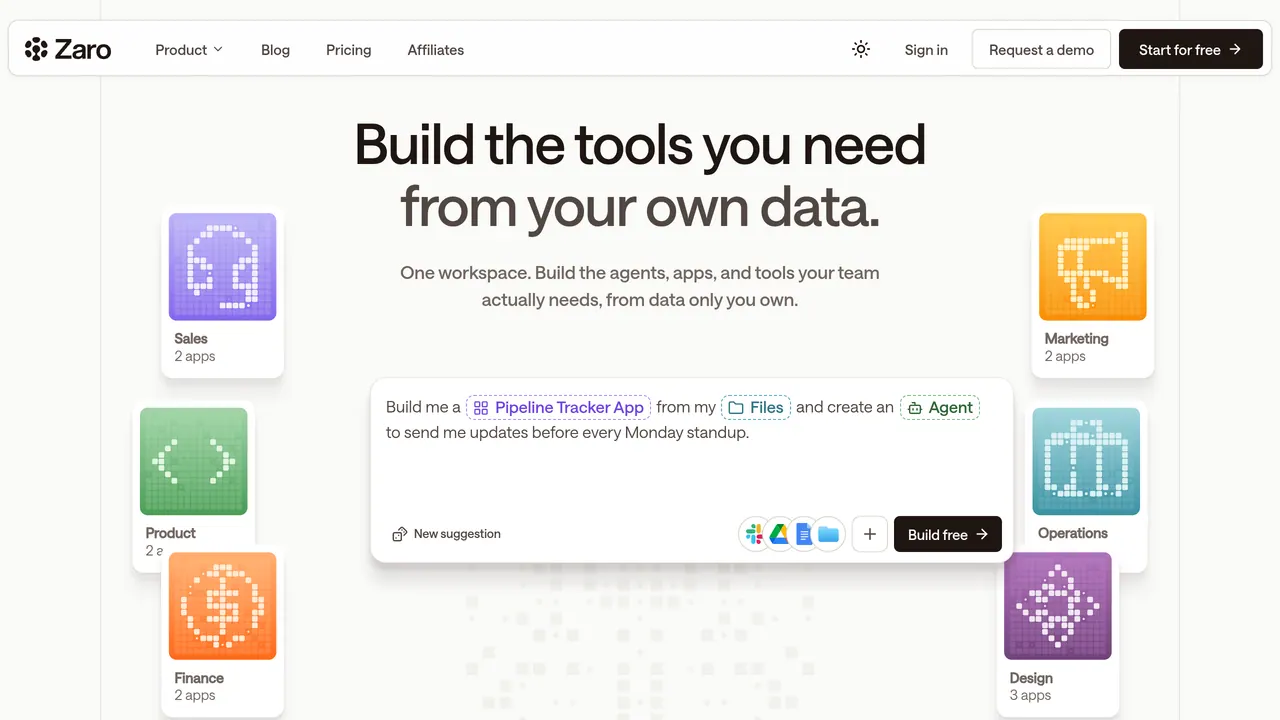
Zaro keeps a company's operating knowledge as plain files that the work itself rewrites, with version history, per-folder permissions and an audit trail, so AI answers name their source file. It sells a fixed-fee pilot of one use case with a decision at day 30, then an annual Enterprise contract; no prices are published.
About Zaro
Zaro's pitch is making a company AI-ready with one current, attributable account of how the business actually runs, rewritten by the work itself as the business changes. Context lives as plain, readable files rather than in a database behind an API, and nothing is overwritten, so you can read any file as it stood on any past date and put it back in one step.
Work writes back as well as reading: each run's output becomes the next run's input, and correcting something once changes the rule, not just that answer. A folder is the unit of access, set to read, write or deny per path for people and automated work alike, and nothing exceeds the permissions of whoever set it up; external tool calls are approved, scoped, monitored and logged from the same layer.
Data comes in through 120+ native connectors, among them SharePoint, Microsoft 365, Teams, Outlook, Salesforce, Confluence, Jira, Slack, Snowflake, Databricks, Google Drive and HubSpot, plus an API, an open agent protocol and a scoped browser session for systems with no API. The homepage's examples cover retail, sales and manufacturing, such as reading every call, email and deal to surface what top sales reps do differently and write the playbook.
A pilot puts one scoped use case live on your real data beside your current process, for a fixed fee tied to deliverables and against success criteria agreed before anything is built; at day 30 you move to Enterprise or walk away. Enterprise is an annual production deployment scoped to your estate, not priced per seat, with EU and UK data residency and a named team.
Sources: zaro.ai, /security, /platform and /getting-started, read 2026-10-27
Zaro pros and cons
Pros
- Every answer names the file it came from, and you can see which version was read and who last changed it.
- The security page says company context is never used to train others' models and stays portable when your needs change.
- Whatever you decide at day 30, you keep the pilot's use cases, documentation and before-and-after measurement.
- The security page lists ISO 27001 and GDPR compliance, and the audit trail records reads, writes, tool calls and outcomes, with exportable history.
Cons
- No prices are published for the pilot or for Enterprise.
- There is no self-serve sign-up or free trial: you start by talking to Zaro's team or taking a 5-minute AI-readiness assessment.
- Enterprise is an annual contract scoped to your estate, and Zaro's pages mention no monthly plan.
Tagged
- Web-based
- Agentic Mode
Zaro alternatives
The closest alternatives to Zaro.
Related reading
Featured on Vibedonalds
Own Zaro? Add this badge to your site to show you’re listed — and link back to your profile here.

<a href="https://vibedonalds.com/tools/zaro" target="_blank" rel="noopener nofollow">
  <img src="https://vibedonalds.com/badge/featured-on-vibedonalds.svg" alt="Zaro — Featured on Vibedonalds" width="240" height="60" loading="lazy" />
</a>Frequently asked questions
- Is Zaro free?
- Zaro is sold through enterprise contracts. Pricing is available from sales.
- What are the alternatives to Zaro?
- The closest alternatives to Zaro are Context Engine, Hexis Cloud.
- What are the downsides of Zaro?
- No prices are published for the pilot or for Enterprise. There is no self-serve sign-up or free trial: you start by talking to Zaro's team or taking a 5-minute AI-readiness assessment. Enterprise is an annual contract scoped to your estate, and Zaro's pages mention no monthly plan.
- What is Zaro?
- Zaro is a company context layer for AI. It keeps one current, attributable account of how a business runs as versioned, permissioned files that the work itself updates, so AI answers name the file they came from and teams can check which version was read.
- How much does Zaro cost?
- Zaro publishes no prices. It starts with a pilot of one scoped use case on your real data for a fixed fee tied to deliverables, with a decision at day 30; after that, Enterprise is an annual production deployment that is not priced per seat.
- Which systems does Zaro connect to?
- The platform page lists 120+ native connectors, naming SharePoint, Microsoft 365, Teams, Outlook, Salesforce, Confluence, Jira, Slack, Snowflake, Databricks, Google Drive and HubSpot. Zaro also offers an API, an open agent protocol and a scoped browser session for systems with no API.
- Does Zaro train AI models on company data?
- No, according to its security page: company context belongs to your workspace, is not used to train someone else's model and remains portable. Permissions follow your workspace model, and sensitive files, folders and tool connections can stay out of reach by default.
- How is Zaro different from a knowledge graph?
- Zaro's homepage says a knowledge graph reads from a snapshot and never writes back, so it is out of date until someone rebuilds it. Zaro instead reads the file itself, so the answer is as current as the last thing the work wrote.