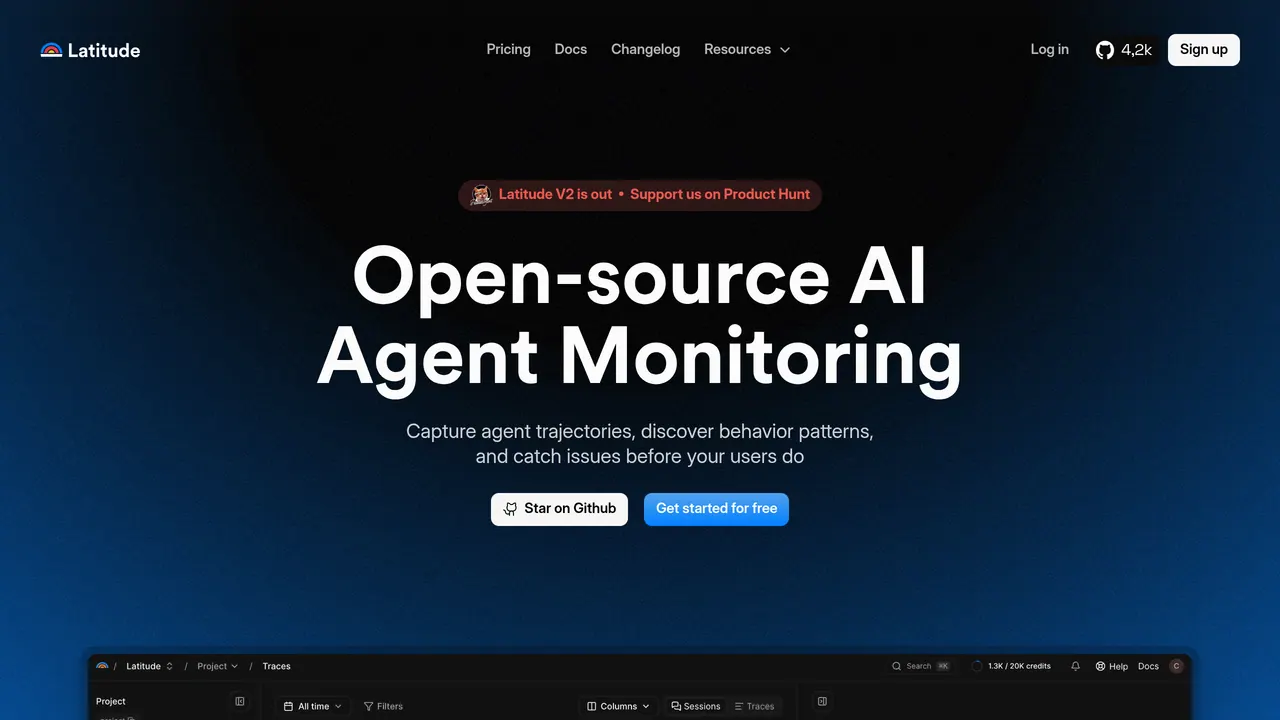
Latitude — Fix what's breaking in your AI agent Open-source platform for building, evaluating, and debugging AI agents.
About Latitude
Latitude is an open-source platform for building, evaluating, and debugging AI agents.
It runs in the browser, so prompt engineering and agent observability happen without local setup. Being open source, it can be inspected and self-hosted rather than used only as a closed service.
It fits teams that want a web-based workspace for prompt and agent work and value open-source code. It is a weaker fit if you need local tooling: there is no listed IDE, CLI, or local integration, only the web platform. Pricing tiers are not publicly documented, which makes cost planning harder.
Among agent-building tools it is the open-source, web-only option, trading local integrations for a hosted workspace you can also self-host.
Sources: this listing
Latitude pros and cons
Pros
- Open-source platform for building, evaluating, and debugging AI agents.
- Web-based interface for prompt engineering and agent observability without local setup.
Tagged
- Web-based
- Agentic Mode
- Open Source
Latitude alternatives
More from AI Coding Agents.
- 01Freemium →Pythagora
Web-app builder agent that generates production-grade apps with backend, DB, and tests.
- 02Free →Kilo Code
Open-source VS Code coding agent merging the best of Cline and Roo Code with extra power-user modes.
- 03Free →Roo Code
Open-source autonomous coding agent for VS Code, forked from Cline with multi-mode workflows.
- 04Freemium →GPT Engineer
Autonomous developer that builds and modifies entire codebases from a high-level spec.
- 05Free →smol developer
Single-prompt full-app generator that builds a project from a one-sentence brief.
- 06Freemium →Sourcegraph Cody
Code-search and AI assistant by Sourcegraph — semantic search across enterprise codebases plus inline coding help.
Related reading
Featured on Vibedonalds
Own Latitude? Add this badge to your site to show you’re listed — and link back to your profile here.

<a href="https://vibedonalds.com/tools/latitude" target="_blank" rel="noopener">
  <img src="https://vibedonalds.com/badge/featured-on-vibedonalds.svg" alt="Latitude — Featured on Vibedonalds" width="240" height="60" loading="lazy" />
</a>Frequently asked questions
- What is Latitude?
- Latitude — Fix what's breaking in your AI agent
- What are the alternatives to Latitude?
- Similar tools in AI Coding Agents on vibedonalds: Pythagora, Kilo Code, Roo Code, GPT Engineer.