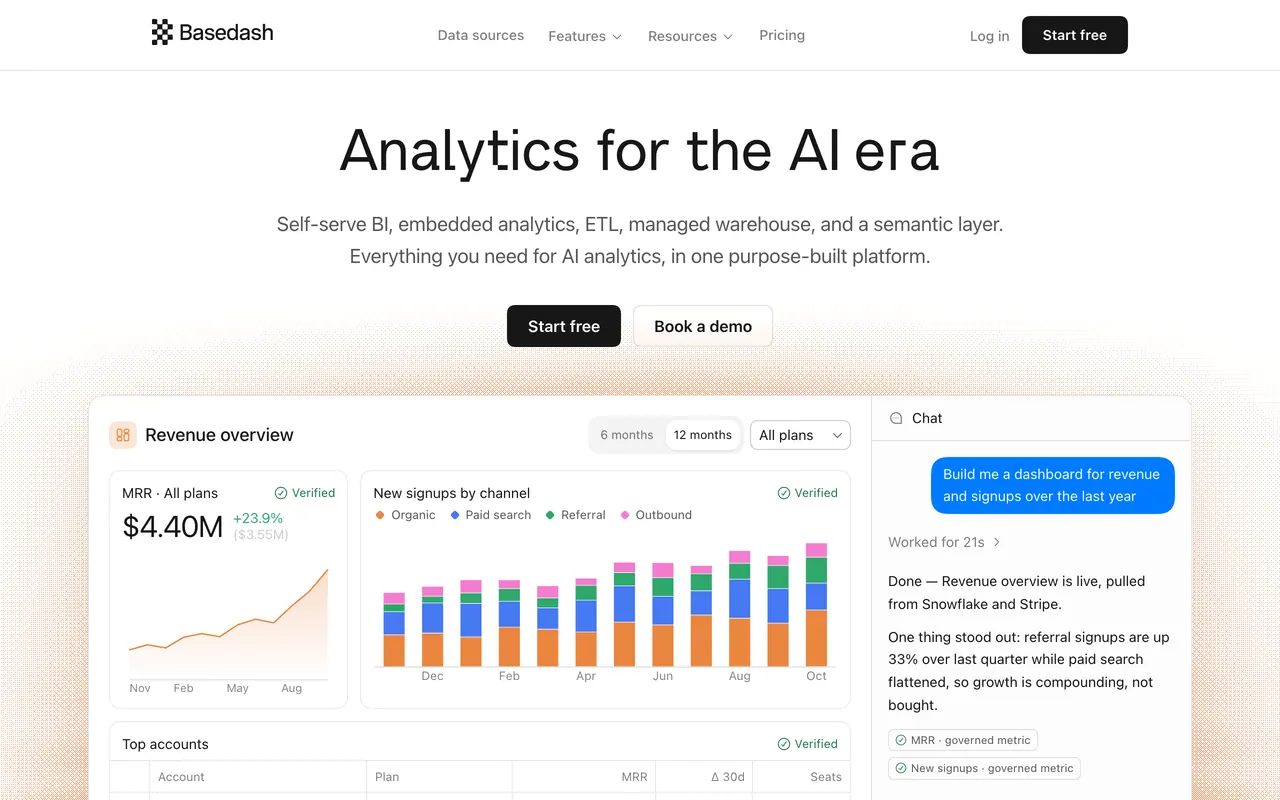
Basedash is an analytics for the AI era Basedash lets team members ask questions in plain English and receive charts, dashboards, or direct answers.
About Basedash
Basedash is an analytics platform for teams, product builders, and AI agents that combines self-serve business intelligence, embedded analytics, data ingestion, a managed warehouse, and a semantic layer. It supports natural-language questions, dashboard creation, monitoring, and agent access through shared models and permissions.
Its AI data analyst produces charts, dashboards, and direct answers from governed definitions and displays the SQL behind each result. Agents can watch metrics continuously, flag changes, explain anomalies, schedule reports, and send briefs to Slack or email, including notifications triggered by data changes.
The platform includes React components for embedding dashboards and chat, white-label controls, row-level customer scoping, and JWT SSO. It also provides a context engine for reusable metrics, segments, business logic, team skills, and existing dbt projects, plus a managed DuckDB warehouse or connections to Snowflake, BigQuery, and Databricks.
Basedash offers Starter, Growth, and Enterprise plans and serves more than 5000 teams worldwide. Its data ingestion product supports hundreds of sources, including Salesforce, HubSpot, Stripe, and Shopify, and is presented as a way to connect them without building a pipeline.
Sources: basedash.com
Basedash pros and cons
Pros
- Basedash lets team members ask questions in plain English and receive charts, dashboards, or direct answers.
- Basedash displays the SQL behind every result to provide auditability and traceability.
- Basedash can embed dashboards and AI chat in products with a few lines of React and white-label them to the customer's brand.
- Basedash connects to Claude, ChatGPT, and Cursor through MCP, offers a REST API, and supports asking questions in Slack.
Cons
- Basedash's managed warehouse uses DuckDB and can also connect to existing Snowflake, BigQuery, or Databricks warehouses.
Tagged
- Supports Claude
- Supports GPT
- Web-based
- MCP Support
Basedash alternatives
More from AI Web Apps.
- 01→HaruOK
Daily check-ins, reminders, and scam protection for aging parents
- 02→LexDye
Catch undefined contract terms and definition errors for your review
- 03→Billable Hub
Track work, invoice clients, and accept Stripe payments with ease
- 04→zQinta
Turn any topic into an AI-powered knowledge tree for learning
- 05→Sell My Data To AI
License company records to vetted AI buyers with rights checks
- 06→Mova
AI job search that finds daily matching roles and tailors applications
Related reading
Featured on Vibedonalds
Own Basedash? Add this badge to your site to show you’re listed — and link back to your profile here.

<a href="https://vibedonalds.com/tools/basedash" target="_blank" rel="noopener nofollow">
  <img src="https://vibedonalds.com/badge/featured-on-vibedonalds.svg" alt="Basedash — Featured on Vibedonalds" width="240" height="60" loading="lazy" />
</a>Frequently asked questions
- What is Basedash?
- Basedash is an analytics for the AI era
- What are the alternatives to Basedash?
- Similar tools in AI Web Apps on vibedonalds: HaruOK, LexDye, Billable Hub, zQinta.
- What are the downsides of Basedash?
- Basedash's managed warehouse uses DuckDB and can also connect to existing Snowflake, BigQuery, or Databricks warehouses.